

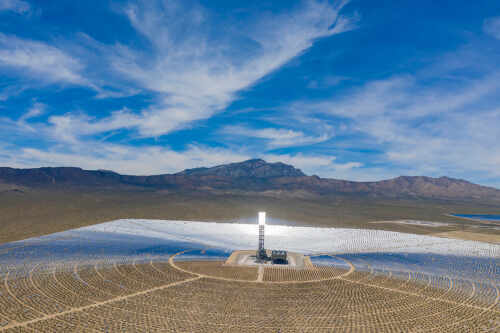
California regulators just blocked the shutdown of a $2.2 billion solar giant that was supposed to revolutionize clean energy but instead became a cautionary tale about technology, economics, and the messy reality of betting big on innovation.
Quick Take
- Ivanpah, the world’s largest concentrated solar thermal plant, faced closure in 2026 after operating just over a decade, but California regulators unanimously rejected the shutdown in December 2025
- The facility generates power for 140,000 homes using 173,500 heliostats and three 459-foot towers, but operates at less than 30 percent capacity efficiency
- Economics drove the closure push: cheaper photovoltaic solar and natural gas undercut Ivanpah’s electricity costs, leaving utilities with little reason to renew contracts
- Grid reliability concerns and sunk cost considerations forced regulators to mandate two of three units remain operational, extending the plant’s lifespan despite its commercial struggles
A Billion-Dollar Bet That Lost the Race
When Ivanpah opened in February 2014, it represented the cutting edge of American renewable energy ambition. The Department of Energy had backed it with $1.6 billion in loan guarantees. Google invested $168 million. NRG Energy committed $300 million. Bechtel built it in 36 months with 7.3 million safe work hours. The facility rose 459 feet above the Mojave Desert, a gleaming monument to what federal backing and private capital could achieve when aligned behind a clean energy vision.
The engineering was genuinely impressive. Nearly 174,000 mirrors concentrated sunlight onto three massive towers, heating steam to 550 degrees Celsius to drive turbines. No thermal storage. No batteries. Pure solar thermal conversion on 3,500 acres of federal land adjacent to Interstate 15. At launch, Ivanpah nearly doubled the amount of solar thermal energy produced across the entire United States.
Then the market moved on without it.
Why Cheaper Always Wins
Ivanpah’s electricity consistently cost more than power from photovoltaic solar panels or natural gas. That single fact, repeated year after year on utility company spreadsheets, proved more powerful than any technological achievement. When utilities could buy cheaper power elsewhere, they had zero incentive to renew Ivanpah’s long-term contracts. Economics, not engineering, wrote the ending.
The plant’s capacity factor—actual energy produced versus maximum potential—languished below 30 percent. For comparison, modern photovoltaic installations routinely exceed this. California regulators shifted subsidies toward photovoltaic and battery storage systems. Even international concentrated solar power projects like Morocco’s Noor facility struggled to remain competitive. The technology that seemed revolutionary in 2010 had become yesterday’s solution by 2020.
The Regulatory Reversal Nobody Expected
In 2025, NRG Energy and its co-owners decided enough was enough. They negotiated a closure agreement with Pacific Gas and Electric, their main customer, to begin shutting down units in 2026. Decommissioning would save money. The technology was outdated anyway. Exit the investment, take the loss, move forward.
Then the California Public Utilities Commission intervened with a unanimous decision that shocked industry observers. In December 2025, regulators rejected the closure agreement outright. Their reasoning revealed the competing priorities that govern infrastructure decisions in the real world: grid reliability concerns and the reality of sunk costs. Two of Ivanpah’s three units would remain operational.
The CPUC’s decision reflected a hard truth about energy infrastructure. When you’ve already spent $2.2 billion and built something that generates power, shutting it down prematurely wastes those sunk costs and potentially creates grid vulnerabilities. Sometimes regulators force you to keep operating an economically challenged facility because the alternative—losing that generation capacity—carries its own risks.
Ivanpah remains operational today, powering roughly 140,000 California homes, visible from Highway 15 as a gleaming reminder of how technology, economics, and policy collide in real time. The facility still represents genuine engineering achievement. But it also embodies an uncomfortable lesson: innovation alone doesn’t guarantee success when market forces move faster than you can adapt.
Sources:
Ivanpah Solar Electric Generating System – Global Energy Monitor
Ivanpah Solar Electric Generating System – Bechtel
Ivanpah Solar Energy Plant California – NASA JPL
Ivanpah Solar Electric Generating System – TripAdvisor