
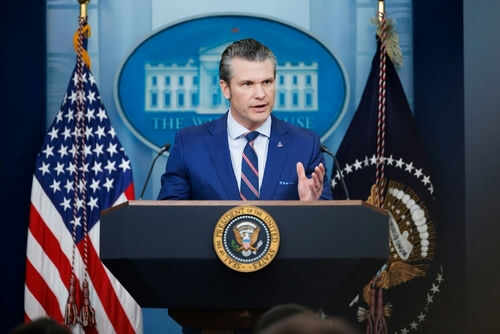
Defense Secretary Pete Hegseth announced Navy Secretary John Phelan’s firing on April 22, 2026, marking the second major Pentagon leadership purge during the ongoing U.S.-Iran conflict as the Strait of Hormuz blockade continues amid disputed claims of American victory.
Story Snapshot
- Navy Secretary John Phelan fired on April 22, 2026, during active Hormuz blockade operations—the second major Pentagon shake-up since war began in late February
- Defense Secretary Hegseth claims Iran “rendered combat ineffective” with 90% of weapons factories destroyed, contradicting intelligence reports showing roughly half of missile launchers intact
- Strait of Hormuz blockade maintained post-ceasefire to pressure Iran into denuclearization negotiations, contributing to gas prices exceeding $4 per gallon
- Trump administration pursues aggressive “negotiate with bombs” strategy as Iranian military faces desertions and morale collapse according to CENTCOM intelligence
Pentagon Leadership Purge During Wartime Operations
Defense Secretary Pete Hegseth terminated Navy Secretary John Phelan on April 22, 2026, during a Pentagon briefing focused on U.S.-Iran war developments and the ongoing Strait of Hormuz blockade. The dismissal represents the second significant military leadership shake-up since Operation Epic Fury commenced in late February 2026. Hegseth’s decision to fire a senior naval official while the Navy maintains critical blockade operations raises questions about internal disagreements over strategy and execution. The Trump administration has demonstrated willingness to swiftly remove officials who fail to align with its aggressive posture toward Iran, reflecting the president’s directive for complete denuclearization through diplomatic pressure or military force.
Blockade Strategy and Ceasefire Claims
U.S. military forces maintain an ironclad blockade of the Strait of Hormuz following a ceasefire announced on April 8, 2026. Hegseth characterized the pause as a U.S. victory, stating American forces are “hanging around” to prevent Iranian nuclear reconstitution. General Dan Caine, Chairman of the Joint Chiefs, reported attack helicopters actively targeting Iranian mines and naval forces while maintaining readiness to resume full-scale operations. The blockade aims to leverage U.S. naval dominance for negotiating leverage, though it has contributed to global oil market disruptions pushing domestic gas prices above $4 per gallon. The administration frames the strategy as necessary to achieve President Trump’s denuclearization objectives, despite economic costs to American consumers.
Contradictory Intelligence on Iranian Capabilities
Defense Secretary Hegseth asserts U.S. and Israeli strikes destroyed approximately 90% of Iran’s weapons factories, ballistic missiles, and naval assets, rendering Iranian forces “combat ineffective.” However, intelligence assessments reveal significant contradictions to these victory claims. CNN sources indicate roughly 50% of Iranian missile launchers remain intact, while residual drone and missile capabilities persist despite heavy losses. Hegseth downplayed these remnants, suggesting surviving assets are “buried in bunkers,” but the discrepancy between official statements and intelligence reports mirrors patterns Americans have witnessed in previous conflicts. CENTCOM intelligence does confirm Iranian military morale is crumbling with rising desertions, yet the gap between Pentagon briefings and battlefield realities raises concerns about transparency with the American public who ultimately bear the costs of extended military operations.
Economic and Strategic Consequences
The U.S.-Iran conflict has produced measurable impacts on American families through fuel price increases exceeding $4 per gallon, directly traceable to Hormuz Strait disruptions. Four U.S. service members died in recent operations according to announcements made the week prior to April 22, reminding citizens that victory declarations come with human costs. The administration’s approach combines overwhelming military strikes with strategic blockade enforcement, betting that sustained pressure will force Iranian leadership to accept denuclearization terms. Critics across the political spectrum question whether the strategy serves ordinary Americans or perpetuates Middle East entanglements benefiting defense contractors and political elites. The firing of Navy Secretary Phelan during active operations suggests internal Pentagon tensions over how aggressively to prosecute the conflict, raising doubts about unified command amid wartime pressures that demand accountability to citizens footing the bill.
The Trump administration’s simultaneous claims of decisive victory and maintenance of an active naval blockade reflect the complex reality of modern conflict, where military dominance does not guarantee political resolution. As the administration pushes Iran toward negotiations while keeping forces positioned for renewed strikes, Americans deserve clarity on endgame objectives, realistic timelines, and total costs—transparency that has historically been lacking from government officials more focused on managing perceptions than leveling with the people they serve.
Sources:
Hegseth claims press is misguiding public about Iran war, warns strikes on Tehran are ramping up