

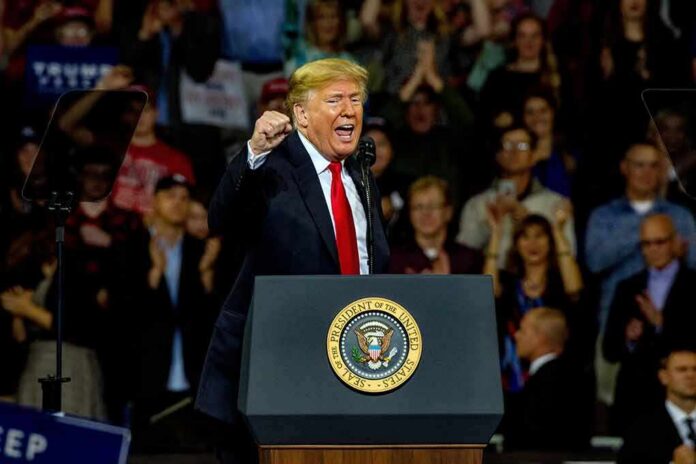
President Trump promised a $5,000 “Trump dividend” to every adult citizen if Republicans win both chambers of Congress, setting up a high-stakes test of policy, cost, and the limits of federal power.
Story Highlights
- Trump tied a $5,000 payment to Republican wins in the House and Senate.
- He branded it the “Trump dividend” and said it must be spent inside the United States.
- Vice President JD Vance pointed to tariff revenue as a possible funding source.
- Analysts say costs could top $1.2 trillion, far above current tariff revenue.
What Trump Promised And Why It Matters
President Trump told voters on September 9, 2026, that if Republicans win the House and the Senate, his administration would issue a $5,000 payment to every adult citizen. He called it the “Trump dividend” and framed it as a reward from a strong economy. He also said the money must be spent in the United States. Multiple outlets captured the remarks and their terms on the day of the speech and the day after, confirming the wording and the condition tied to the midterms.
Vice President JD Vance later said tariff revenue could fund the plan, describing it as a dividend for workers. That idea set the first possible path for how the checks might be paid. Trump’s remarks did not cite a legal mechanism or a budget source. The promise depends on Republicans controlling both chambers, which means any follow-through would have to move through the regular process in Congress after the election window.
The Price Tag And The Revenue Gap
Independent estimates place the total cost around $1.2 to $1.3 trillion for one round of payments. Analysts note that current annual tariff revenue is far lower, around one tenth of the needed sum by some tallies. That gap raises questions about deficits, debt, and inflation risk if Congress had to borrow to bridge the difference. Economists cited by major outlets warned the plan could swell the deficit and put new heat under prices if enacted at full scale.
Because Trump’s speech did not include eligibility fine print beyond “every adult citizen,” key design choices remain open. Congress would have to decide how to verify citizenship, whether to cap income, and how to administer the spending-only-in-America rule. Those choices affect cost and speed. The record so far shows no enacted bill, appropriation, or executive directive setting up a payment system, which indicates the concept is still a promise awaiting legislative shape.
Legal And Political Hurdles Ahead
Critics from both parties argued the payments would need congressional approval under the Constitution’s spending power. Some skeptics inside the Republican Party also warned about inflation risks and the politics of a trillion-dollar transfer. Others questioned whether any president could make good on such a large promise by executive order alone. These objections do not change what Trump pledged, but they highlight the legal gatekeepers and the legislative math that would decide the outcome.
For conservative voters, the stakes are clear. Washington has driven up debt for years while families pay more for gas, food, and power. Trump put a concrete number on relief and tied it to winning Congress. If Republicans deliver majorities, lawmakers will face a choice: craft a lawful, funded version that protects taxpayers and tempers inflation risk, or put forward targeted alternatives that still put American workers and production first.
Sources:
pbs.org, bbc.com, aljazeera.com