

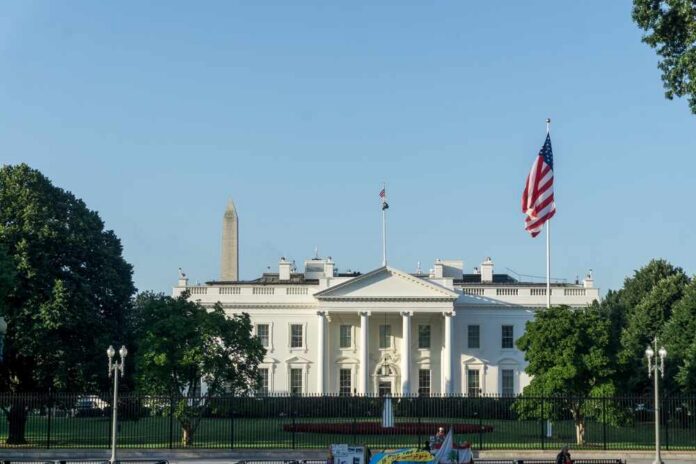
A secretive push to turn the White House bunker into a long-stay command center could reshape presidential security—and raise uncomfortable questions about accountability—long after the current headlines fade.
Quick Take
- President Trump has publicly described a major expansion of the White House Presidential Emergency Operations Center (PEOC) beneath a proposed ballroom, including features like bomb shelters and a hospital.
- A federal court ruling has allowed underground work to proceed by treating it as national security-related construction rather than part of the ballroom project.
- Continuity-of-government doctrine has historically favored evacuating the president away from the White House, not building a deeper long-term hub at a known target location.
- With limited public detail on scope, cost, or congressional involvement, the project is fueling suspicion across the political spectrum that “the system” operates without transparency.
What Trump Says Is Being Built Under the Ballroom
President Trump has described a large expansion of the White House’s PEOC, the underground facility commonly referred to as the “bunker.” The plan includes bomb-shelter elements, a hospital capability, hardened structures described as missile-resistant, and ceilings described as designed to defeat drones. Trump has also indicated the military is involved and that construction is already underway.
The debate starts with an obvious tension: any president has a legitimate duty to protect the presidency during crisis, but the public is being asked to accept an unusually ambitious project with almost no official detail. The sources available describe no public blueprints, no formal cost figures, and no clear accounting of how the expansion fits into longstanding continuity plans. That information gap is exactly what tends to trigger bipartisan distrust of Washington.
Why Continuity Plans Traditionally Avoid “Riding It Out” at the White House
Continuity-of-government planning has long treated the White House as a symbolic and operational center, but also as a predictable target. Reporting on the PEOC’s history describes it as a short-term crisis workspace—useful for hours, not weeks—while the broader doctrine focuses on quickly relocating the president to secure sites away from Washington. The logic is simple: a fixed, well-known location is easier to target than a moving, dispersed leadership.
That’s why critics argue the concept of a deeper, more capable White House bunker may conflict with the mobility principle. If an adversary already assumes the White House is a prime target in extreme scenarios, expanding underground capacity could concentrate even more critical functions in the same geographic footprint. Conservatives who emphasize national defense readiness may reasonably ask whether a hardened “stay-put” concept improves survivability—or creates a more tempting, high-value bullseye.
The Legal Green Light: Bunker Work, Not Ballroom Work
The latest concrete development is legal rather than architectural. A federal judge clarified that underground construction could continue because it is tied to national security, distinguishing it from the contested ballroom project above. That ruling matters because it effectively separates the bunker expansion from the more publicly understandable “ballroom” narrative, allowing the most sensitive portion of the work to proceed under a different justification.
Legally, that distinction may be clean. Politically, it lands in a country where trust is already thin. Many Americans—on the right and left—believe the federal government too often uses classification and “national security” labeling to avoid oversight. With Republicans controlling Congress in 2026, Democrats will likely frame the bunker as executive overreach; meanwhile, some MAGA-aligned voters may see the controversy as another attempt to undermine Trump regardless of facts.
Security Upgrade or Governance Risk? What the Evidence Can and Can’t Prove
One analysis warns that a long-term underground hub could, in theory, be misused during a constitutional confrontation by letting a president and loyal staff operate while physically insulated from outside pressure. That scenario is speculative, and the reporting available does not provide evidence that any such plan exists or that the construction is intended for political entrenchment. Still, the concern resonates because it matches a broader pattern: citizens feel rules change depending on who holds power.
The secret bunker underneath the White House could compromise American security for decades to comehttps://t.co/wKcL1jh9aV via @YouTube
— Patriot Pepe (@Aldebaran519) May 1, 2026
The more grounded issue is oversight and doctrine. If the PEOC is being transformed from a short-term shelter into a complex capable of extended operations, Congress and the public will eventually demand to know how that aligns with evacuation-based continuity planning, how costs are controlled, and what checks exist to prevent mission creep. When government asks Americans to “trust us” without details, it usually deepens the very institutional skepticism leaders say they want to reduce.
Sources:
The Trouble with Trump’s Bunker and Ballroom
Construction of White House bunker, not ballroom, gets green light