

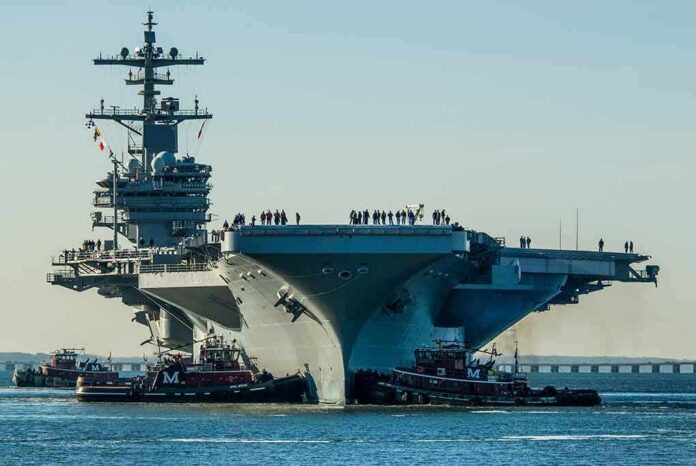
The Navy says eight sailors in the USS Abraham Lincoln strike group attempted suicide during deployment, but none died, sharpening calls for straight answers and stronger care for our troops.
Story Highlights
- Acting Navy Secretary Hung Cao told Congress there were eight suicide attempts across the Lincoln strike group and zero suicides during deployment.
- The total covers the carrier, air wing, staffs, escorting destroyers, and embarked squadrons, not only the carrier crew.
- Cao confirmed one prevented overboard attempt in April and a separate overboard incident in August.
- The Navy says Lincoln sailed with chaplains, clinicians, technicians, and other mental-health support on board.
Official Letter Confirms Attempts, Reports No Deaths
Acting Secretary of the Navy Hung Cao wrote to Senator Kirsten Gillibrand on September 22 that eight sailors assigned to the USS Abraham Lincoln carrier strike group attempted suicide during the deployment, and that there were no suicides on board during the deployment period. The letter is a formal response to congressional oversight, not a casual press comment. The Navy’s statement sets the facts in writing, which matters for families, lawmakers, and taxpayers who expect clear records.
Cao’s letter defines the eight attempts as covering Carrier Strike Group Three personnel. That includes the carrier crew, the air wing, the strike-group and destroyer-squadron staffs, the escorting destroyers, and the embarked aviation squadrons. News coverage repeated that scope, helping readers avoid a common error of counting every attempt as a carrier-only event. Clear scope prevents confusion and lets leaders target help to the right units rather than chase headlines.
Overboard Incidents Acknowledged During Lengthy Cruise
Media reports say Cao confirmed one sailor tried to go overboard in April and another sailor went overboard in August during the deployment. Those events are serious and frightening for shipmates who rushed to respond. They also show why the phrase “no suicides” cannot stand alone as the full story. Attempts still happened, and crews faced real emergencies at sea. That is why documentation and follow-through now matter as much as the headline number.
The ship’s return to San Diego followed an unusually long, high-pressure deployment that drew national attention and intense family concern. Extended time at sea strains even strong crews. Long watches, tight spaces, and missed port calls wear on morale. Families and some sailors told reporters about low morale and suicidal thoughts, matching the formal count of eight attempts across the broader strike group. These accounts deserve review, not dismissal.
Navy Lists Onboard Support, But Use And Results Need Clarity
The Navy says Lincoln deployed with multiple chaplains, an embedded prevention counselor, a psychologist, a clinical social worker, behavioral-health technicians, and even a facility dog to help the crew. That is a sizable footprint for a ship. Still, a list of resources does not reveal how fast sailors got help, how many used services, or whether command climate encouraged care. Congress and the public should see anonymized data on access, wait times, and outcomes.
National outlets pressed for details on the eight attempts but reported the Navy did not release incident-by-incident data for most cases. Without dates, locations, or outcomes, the public cannot judge patterns or fixes. Precision matters. Separate the carrier-only events from those on escorts. Explain how overboard cases are classified. Confirm the “no suicides” claim against casualty records. These steps protect privacy while showing respect for sailors and families who lived this deployment.
What Accountability Looks Like Under President Trump
President Trump and Vice President JD Vance have said they back strong forces with strong families. That stance fits this case. The administration should direct the Navy to publish a clean, anonymized timeline of all eight attempts, with unit-level sorting and definitions that regular readers can understand. Leaders should pair that with trend data from before, during, and after deployment so the raw count does not hide real risk or inflate fear without cause.
Congress should also require a crew survey on sleep, work hours, leadership climate, and access to care, again with privacy safeguards. Commanders need facts, not spin, to fix root problems. Conservative readers value truth, chain of command, and mission readiness. A clear record of what happened on the Lincoln strike group honors all three. The letter to Senator Gillibrand is a start; the follow-through now must match the stakes at sea.
Bottom Line For Readers
The facts are firm on the key point: eight suicide attempts across the Lincoln strike group, no suicide deaths during the deployment window. The Navy confirms two overboard-related events within those attempts. The service lists real mental-health resources on board. The next step is sunlight with care. Publish the anonymized details, measure results, and fix what failed. Our sailors went long and hard for the mission. They earned clear answers and better tools.
Sources:
youtube.com, gillibrand.senate.gov, abcnews.com, apnews.com, usatoday.com, nbcnews.com