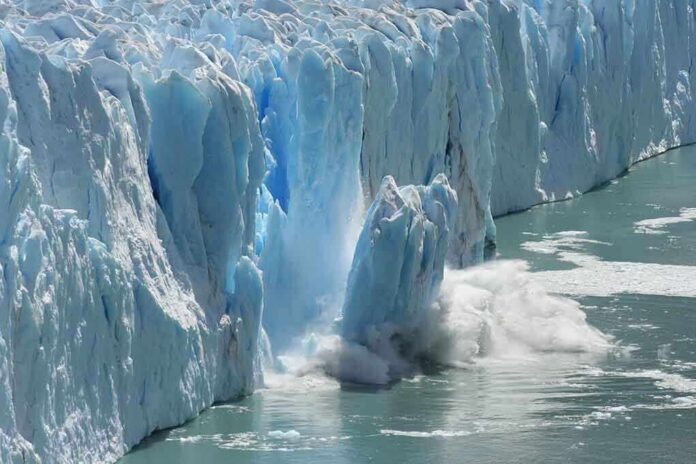
A new study finds Antarctica’s Thwaites “doomsday” glacier will keep shrinking for decades even if the ocean cools, a reminder that coastal preparedness—not panic—is the responsible path forward.
Story Highlights
- Three advanced ice-sheet models show Thwaites keeps losing ice even with zero ocean melting applied in tests.
- Scientists say today’s retreat partly reflects past changes, so ocean cooling alone cannot reverse the trend this century.
- Field teams report complex bedrock, water-bearing sediments, and subglacial lakes that can drive continued retreat.
- Researchers expect ongoing retreat and faster flow, but they do not claim imminent total collapse.
What The New Research Tested And Found
Researchers ran three state-of-the-art ice-sheet models to test a simple idea: what if warm ocean melting stopped right now? The answer was striking. Thwaites Glacier kept losing mass for the next 150 years in all three models, though the rate slowed over time. The team concluded that current retreat is partly a delayed response to earlier changes. That means future ocean cooling alone cannot flip the glacier back to growth on policy-relevant timelines.
Study authors also clarified what the result does not prove. The experiment is a sensitivity test, not a forecast that oceans will suddenly cool to that level. It also does not claim Thwaites is locked into a full, unavoidable collapse. It shows persistence of net loss under an extreme “no ocean melt” case, while total disintegration timing remains uncertain. The message is clear but bounded: expect continued retreat, not instant catastrophe or instant recovery.
Why The Glacier Keeps Retreating Anyway
Scientists point to the ground beneath the ice as a key reason. The bed under Thwaites is not smooth or simple. It varies a lot, includes steep slopes, and holds widespread water-bearing sediments. An active subglacial lake adds more moving parts. These features help the ice slide and shift even when broad under-ice melting is weaker than expected. That complex base can sustain retreat and speed changes, separate from year-to-year ocean swings.
Recent field campaigns also found mixed melt patterns. Large areas under the ice shelf showed weaker melt than many assumed, yet melting raced along cracks and crevasses. The glacier is still retreating. This shows the system does not respond like a thermostat with one dial. The shape of the bed, the location of fractures, and the way water moves below the ice all matter. These processes can push retreat forward even when average melt is modest.
What This Means For Coastal Communities And Policy
British Antarctic Survey materials say Thwaites has been retreating for more than 80 years, with a major acceleration in the last 30, and they expect more retreat through this century and the next. They add that complete disintegration in the next few decades is unlikely. That framing matches the modeling message: steady pressure on sea levels, not a Hollywood-style cliff event. Coastal planners should prepare with levees, zoning, and resilient infrastructure now.
For conservative readers, the practical takeaway is straightforward. Focus on real risks and smart investments, not sweeping energy mandates that punish families. Local and state leaders can harden ports, protect power stations, and improve drainage without wrecking the economy. Federal agencies can streamline permits, cut red tape, and back cost-effective defenses. Good stewardship means spending wisely, guarding property rights, and keeping communities safe as seas rise over time.
Cut Through Hype: Facts, Limits, And Next Steps
The new models agree on direction, but scientists admit gaps in the fine details. The bed is too complex to map perfectly today, and that limits exact timing claims. Researchers call for more direct measurements under the ice, plus shared code and full experiment sets to test other ocean scenarios, like gradual cooling or regional current shifts. That work will sharpen estimates while avoiding panic or false certainty about clockwork collapse dates.
President Trump’s administration can back serious data gathering and common-sense resilience while rejecting alarmist branding like “doomsday.” The duty is to protect Americans’ homes, jobs, and ports with efficient, accountable projects. The science says Thwaites will likely keep adding pressure to sea levels for a long time. The right answer is disciplined planning, strong local control, and a clear focus on results—not ideology, not fear, and not blank checks.
Sources:
bas.ac.uk, ess.uci.edu, meetingorganizer.copernicus.org, nora.nerc.ac.uk, thwaitesglacier.org