

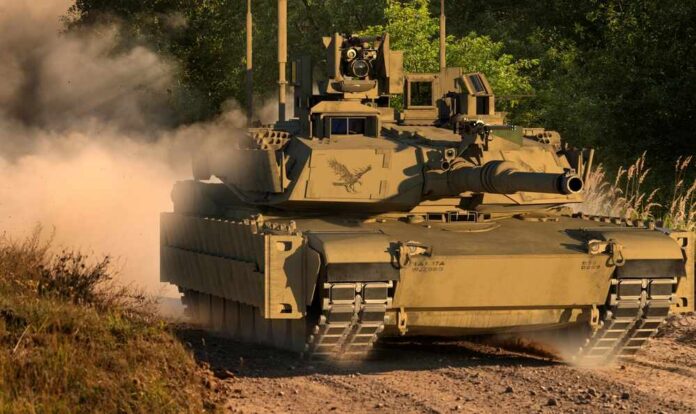
A “cheap” new tank-killer may save money on paper, but it also highlights a harder truth for voters: Washington is preparing for bigger, longer wars even as the country is already fighting Iran.
Quick Take
- The U.S. Army is pivoting from the M1A2 SEPv4 upgrade path toward a lighter, more modular M1E3 Abrams, with prototypes slated for unit evaluation in 2026.
- The Army also placed a major order for Switchblade loitering munitions described as “tank killers,” reflecting lessons from Ukraine where inexpensive drones and ATGMs have threatened heavy armor.
- Supporters of President Trump’s second term are split: some back decisive action abroad, while others see the Iran war as another slide toward open-ended intervention.
- The “1/10th price” framing is largely a comparison between disposable anti-armor systems and the enormous total cost of modern tanks, not a single confirmed program promise.
Why “Tank-Killers” Are Back in the Spotlight
The Army’s renewed focus on low-cost anti-armor weapons is tied to battlefield reality, not marketing. Fighting in Ukraine showed how drones and guided missiles can destroy or disable armored vehicles that cost vastly more to buy, fuel, and maintain. That lesson is landing at the same time Americans are watching another conflict expand, with U.S. forces now at war with Iran. For voters burned out on “forever wars,” the procurement shift reads like preparation for prolonged conflict.
The clearest recent example is the Army’s order of Switchblade loitering munitions, including a 300 Block 2 variant described in reporting as a “tank killer,” designed for beyond-line-of-sight strikes with an explosively formed penetrator warhead. The contract value cited in reporting is large, but the unit concept is small: portable, expendable systems that can be fielded widely, including to light forces that cannot bring heavy anti-armor platforms everywhere.
The M1E3 Abrams: Lighter, Faster to Upgrade, Built Around Protection
The M1 Abrams entered service in the 1980s and has grown heavier with successive upgrades, creating real logistics burdens. Army planning now emphasizes a new M1E3 Abrams direction focused on weight reduction and built-in survivability rather than bolted-on fixes. Reporting describes ambitions for hybrid propulsion, modular architecture, and integrated active protection systems meant to defeat incoming threats. The Army has also discussed faster, software-driven iteration, reflecting how quickly drones and sensors evolve.
Timelines in reporting suggest an unusually compressed path: after the Army publicly pivoted away from the M1A2 SEPv4 track, General Dynamics Land Systems received design work and delivered an initial prototype by late 2025, with additional prototypes expected in 2026 for testing and soldier feedback. If that schedule holds, the Army would move toward fielding earlier than traditional armor programs. Key details remain fluid, and some requirements are not public, limiting outside verification.
The “1/10th Price” Claim: Real Savings, but Not a Free Lunch
The “bargain” narrative comes from comparing the cost of single-use anti-armor weapons to the price tag of a modern tank, often cited as many millions of dollars once procurement and support are counted. Some commentary highlights ultra-low per-shot costs, even suggesting figures around $10,000 for certain “tank-killer” concepts. What is clearer in the underlying reporting is the direction of travel: the Army wants more shots, more distributed lethality, and more ways to kill armor without betting everything on a few exquisite platforms.
That logic can be fiscally attractive, but it also fits a warfighting model that expects attrition and mass use. When Washington buys large quantities of disposable strike systems while accelerating a new tank program, it signals planners are preparing for high-tempo conflict against well-armed enemies. For conservatives angry about inflation, energy prices, and federal overspending, the key question is whether the Iran war expands into a broader, open-ended commitment that drives yet another round of emergency appropriations and “must-pass” spending packages.
Political Reality in 2026: A Base That Wants Strength Without Another Iraq
In Trump’s second term, many loyal voters still prioritize strength, deterrence, and a military that can win. At the same time, the Iran war has sharpened an older divide on the right: the desire to avoid regime-change thinking and to demand clear objectives, defined end states, and constitutional accountability for major military commitments. That split also shows up in debates about how closely U.S. strategy should be tied to allies and regional partners, including Israel, when the costs land on American families.
The procurement story matters because it connects to what citizens can measure at home: fuel costs, supply-chain stress, and the risk of a permanent war footing. None of the cited reporting claims the M1E3 or Switchblade purchases are specifically “for Iran,” but the timing lands during active conflict, making skepticism inevitable. If policymakers want public backing, conservatives will look for transparency on strategy, a realistic budget, and a serious commitment to avoiding mission creep.
Sources:
https://www.motortrend.com/news/us-army-m1e3-abrams-prototype-first-look
https://www.twz.com/land/m1e3-abrams-next-gen-tank-pre-prototype-to-be-delivered-by-end-of-year
https://www.19fortyfive.com/2026/02/oops-the-u-s-military-cant-build-a-military-anymore/