
Europe is scrambling to protect the world’s oil lifeline after the Hormuz chokepoint became collateral damage in the U.S.-Israel conflict with Iran.
Quick Take
- French President Emmanuel Macron says France and partners are preparing a defensive naval mission to escort commercial ships through the Strait of Hormuz once the situation is “calmer.”
- The Strait of Hormuz carries roughly 20% of global oil trade, and disruptions have helped push oil prices above $100 a barrel for the first time since 2022.
- French planning is underway, but key operational details—timeline, participating countries, and command structure—remain unspecified
- USNI News reports the French Navy has pledged 10 additional warships for Middle East escort duties tied to Hormuz.
Macron’s Promise: Escorts, But Only After the “Intense Phase”
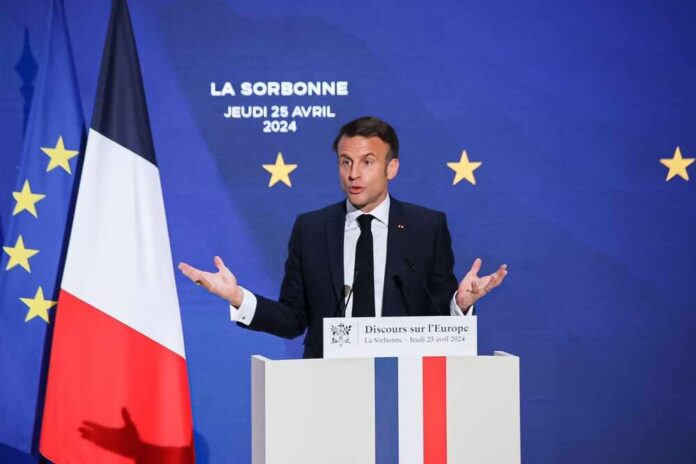
French President Emmanuel Macron said March 9 that France and allied partners are preparing a naval mission to escort container ships and tankers through the Strait of Hormuz, but only once the most intense phase of the U.S.-Israeli conflict with Iran subsides. Macron described the effort as “strictly defensive,” aimed at restoring maritime security and freedom of navigation so commercial traffic can gradually resume.
Macron made the announcement during a visit to Cyprus as the region absorbs escalating military strikes and retaliatory missile and drone attacks that have rattled shipping confidence. The message is straightforward: Europe wants ships moving again without advertising a new offensive coalition. That framing matters, because escort missions can deter harassment while also risking miscalculation if Iran interprets multinational warships as a direct challenge rather than a protective screen for commerce.
Why Hormuz Matters: A 21-Mile Chokepoint With Global Consequences
The Strait of Hormuz is a narrow 21-mile-wide passage between Iran and Oman that handles about 20% of global oil trade, making it one of the most strategically sensitive waterways on earth. When traffic stalls, the shock hits ordinary families fast through gasoline and heating costs, plus knock-on price increases across the economy. Reporting cited oil rising above $100 per barrel for the first time since 2022 as strikes and counterstrikes disrupted the strait’s shipping environment.
Historical precedent explains why markets panic when Hormuz is threatened. Tensions tied to Iran’s post-1979 posture have repeatedly spilled into maritime confrontation, including the 1980s Tanker War and the 2019 cycle of tanker seizures and attacks. After those 2019 incidents, the U.S. backed the International Maritime Security Construct to protect shipping. Europe also pursued separate efforts such as EMASoH, which focused more on monitoring and awareness than physically escorting tankers.
What France Is Bringing: Warships, Signaling, and a European-Led Posture
USNI News reported the French Navy pledged 10 additional warships for Middle East escorts specifically tied to Hormuz, a concrete indicator that Paris is preparing for more than a symbolic role. Macron’s broader pitch also suggests a European-led effort that could include non-European partners, though current reporting does not confirm whether the mission would be coordinated through NATO, the EU, or a standalone coalition. That uncertainty matters for rules of engagement and accountability at sea.
France’s stated motivation aligns with basic national interests: protect energy flows, stabilize markets, and reduce pressure from inflation that tends to punish working households first. From a conservative lens, the lesson is that energy security is national security—and when chokepoints break, everyday costs rise while bureaucrats debate terminology. Escort missions are one of the few practical tools short of escalation that can restore predictable commerce, but they also demand clear command-and-control to avoid accidents.
Strategic Risks: Defensive Escorts Can Still Trigger Escalation
Macron’s “strictly defensive” language reflects an awareness that Iran may portray escorts as provocation. Even a protective convoy posture can become a flashpoint if drones, missiles, mines, or fast-attack craft force split-second decisions. It also indicates this plan depends on calmer conditions, implicitly acknowledging that attempting escorts during active bombardment could be unsafe or politically combustible. With no named partners or timeline, analysts should treat the plan as contingent rather than imminent.
The broader geopolitical impact is hard to ignore. Higher oil prices can benefit oil exporters, and reporting referenced Russia potentially profiting from elevated prices, adding another layer to the strategic cost of instability. For U.S., the takeaway is that overseas disruptions still land at home through prices and supply chains, and allies are positioning themselves to manage the fallout. Limited public detail in current reporting means the mission’s scope, duration, and deconfliction mechanisms remain open questions.
Sources:
France, allies preparing mission to escort ships through Strait of Hormuz, Macron says
French Navy Pledges 10 Additional Warships to Middle East Escorts for Strait of Hormuz