
Britain’s left-leaning leadership just proved that, when missiles start flying, even “globalist” politics can’t replace hard-power alliances—and the U.S.-UK military relationship is back at the center of a rapidly escalating Iran showdown.
Quick Take
- UK Prime Minister Keir Starmer confirmed U.S. aircraft are operating from UK bases for what his government calls limited defensive strikes against Iranian missile threats.
- The move follows Iran’s retaliatory drone and missile attacks on U.S. bases in the Gulf that killed six American service members.
- President Donald Trump criticized Starmer’s initial hesitation, underscoring friction inside the alliance even as operations proceed.
- Starmer and U.S. Defense Secretary Pete Hegseth emphasized the mission is targeted and not a repeat of Iraq-style “endless war.”
Starmer’s “Special Relationship” Defense Meets a Real-World Test
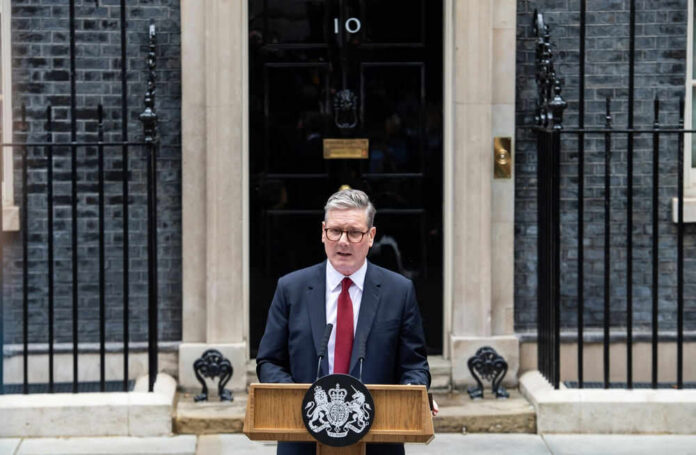
UK Prime Minister Keir Starmer told Parliament that American planes flying out of British bases show the “special relationship in action,” after authorizing limited U.S. use of UK facilities for defensive strikes tied to Iran’s missile campaign. The shift comes after Iran launched missiles and drones at U.S. positions in the region, raising pressure for rapid response options. Starmer also highlighted British aircraft activity aimed at stopping incoming drones and missiles.
Stars and Stripes reported U.S. aircraft are operating from installations including RAF Fairford and Diego Garcia, with the stated purpose of hitting Iranian missile depots and launchers. The reporting aligns with Starmer’s public emphasis that Britain is enabling defensive action rather than joining offensive raids. That distinction matters politically inside the UK, where Iraq-era memories remain potent, and strategically for Washington, which wants speed without broadening the coalition footprint.
What Triggered the Pivot: Strikes, Retaliation, and American Casualties
The current escalation traces back to joint U.S.-Israeli strikes over the weekend of Feb. 28–March 1 that targeted Iran’s nuclear program and killed Iran’s supreme leader Ayatollah Ali Khamenei, according to the provided reporting. The UK was not involved in those initial offensive strikes. Iran then retaliated with what was described as a “scorched earth” wave of missiles and drones against U.S. bases in Bahrain, Qatar, and the UAE, killing six U.S. service members.
On March 1, Starmer released a video statement granting U.S. forces permission for limited defensive use of UK bases. On March 2, he defended the decision to Parliament while acknowledging the tension that comes with balancing deterrence and escalation risk. Starmer had urged restraint alongside France and Germany before the retaliation, then moved toward support after attacks on allied forces—an evolution that mirrors how fast Middle East crises can outrun cautious diplomacy.
Why RAF Fairford and Diego Garcia Matter to U.S. Strategy
RAF Fairford and Diego Garcia are not symbolic outposts; they are practical launch points that extend American reach while reducing reliance on crowded or vulnerable regional basing. The background notes RAF Fairford has supported U.S. air operations since the Cold War era, and Diego Garcia has been leased to the U.S. since 1966 as a key Indian Ocean platform. In a missile-heavy conflict, geography and logistics can decide the tempo.
That basing advantage also explains the political stakes. Authorizing foreign strike missions from national territory invites domestic backlash, but denying access can weaken deterrence and strain allied trust. For a conservative American audience watching from the Trump era, the takeaway is straightforward: forward basing and tight alliances remain the backbone of credible defense, even when European leaders campaign on restraint. The limited nature of the authorization is central to Starmer’s argument.
Trump’s Pressure, Hegseth’s “Not Iraq” Message, and the Limits of Trust
The reporting states President Trump criticized Starmer’s initial denial of base access, and Starmer later leaned hard into alliance language to justify the decision. That sequence matters because it shows the “special relationship” is not automatic; it is negotiated under pressure. The U.S. can bring unmatched capability, but partners still weigh domestic politics first. For Americans who remember years of allied free-riding debates, the episode illustrates why U.S. leadership demands clarity and commitment.
U.S. Defense Secretary Pete Hegseth framed the operation as limited and explicitly not “Iraq” or “endless,” language designed to reassure war-weary publics while keeping attention on immediate missile threats. It does not provide independent verification of strike outcomes beyond the stated aim of destroying launchers and depots, and it remains unclear how Iran will respond next. The central confirmed facts are basing access, ongoing operations, and the casualty-driven urgency.
Prime Minister Keir #Starmer defends his handling of the US-Israeli war against Iran after President Donald #Trump launched a scathing attack over the British leader’s initial refusal to allow the Americans to use UK air bases.https://t.co/XqBzzQAKR5
— Al Arabiya English (@AlArabiya_Eng) March 4, 2026
For now, Starmer is betting that emphasizing defensive intent and alliance necessity will contain political fallout at home while helping protect U.S. forces abroad. The near-term risk is that Iran could treat UK bases as part of the operational chain and escalate threats accordingly, a point implied the potential retaliation. The near-term reality is also hard to ignore: six Americans are dead, missiles and drones are in play, and fast-response basing is not optional.
Sources:
Starmer says US planes flying out of UK bases ‘special relationship in action’
UK agrees to let US use British bases for defensive strikes on Iran after attacks on American troops