

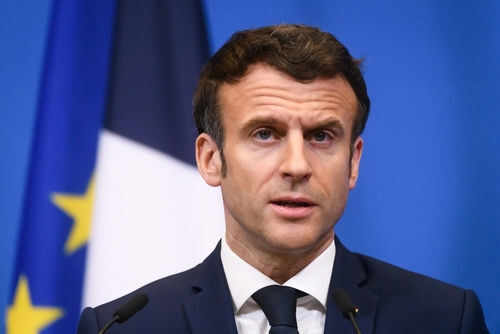
France just branded the U.S.-Israel strikes on Iran “illegal” while simultaneously moving warships and air defenses into the region—an alliance split that could reshape what comes next.
Story Snapshot
- President Emmanuel Macron said the U.S.-Israeli operations against Iran were conducted outside the framework of international law, and France “cannot approve” them.
- Macron announced France is deploying the aircraft carrier Charles de Gaulle, escort frigates, and additional air-defense and radar assets to protect French and partner interests.
- France said it downed drones in the earliest hours of the conflict in what it described as legitimate self-defense of allied airspace.
- Macron urged an immediate end to airstrikes and warned an Israeli ground operation in Lebanon would be a dangerous escalation and strategic mistake.
- France proposed a new international maritime security coalition focused on keeping shipping routes safe amid widening regional conflict.
Macron’s Legal Break With Washington and Jerusalem
President Emmanuel Macron delivered a televised national address on March 3–4 condemning the U.S.-Israeli strikes on Iran as operations conducted “outside the framework of international law.” Macron’s wording matters because it publicly separates a major Western ally from the military campaign’s legitimacy, not merely its timing or tactics. The available reporting does not include detailed U.S. or Israeli legal arguments, leaving the dispute framed primarily by France’s objections and calls for restraint.
Macron’s stance lands in the middle of a rapidly escalating timeline. The U.S. and Israel launched large-scale coordinated attacks on Iran on March 1, with nearly 800 people reportedly killed, including Iran’s Supreme Leader Ayatollah Ali Khamenei. Tehran then retaliated with drone and missile strikes targeting Israel and Gulf nations hosting U.S. military assets. Macron also faulted Hezbollah strikes from Lebanon as a trigger that widened the conflict and put civilians at risk.
France Deploys Forces While Calling for De-Escalation
France paired its legal criticism with hard power. Macron confirmed deployment of the aircraft carrier Charles de Gaulle, its air wing, and escort frigates into the Mediterranean, alongside air-defense systems and airborne radar units. Additional French air-defense assets were sent to the Greek Cypriot Administration. Macron said French forces shot down drones in the conflict’s first hours, describing the actions as legitimate self-defense protecting allied airspace.
France also tightened security at home. Officials said Paris strengthened the Sentinel military protection posture and increased vigilance around exposed locations and individuals. The combination of overseas deployments and domestic measures underscores how quickly Middle East conflict can create security ripple effects inside Europe. For American readers who prioritize national sovereignty and public safety, the key takeaway is that even distant wars can drive immediate force posture changes and heightened internal security in allied capitals.
UN Legitimacy Fight Highlights a Bigger Governance Divide
France’s foreign minister, Jean-Noël Barrot, argued the strikes should have been debated in international bodies “set up for this exact purpose,” pointing to the United Nations and insisting that use of force gains necessary legitimacy through the UN Security Council. Whether Americans agree with the UN’s track record, the practical point is that Macron is pressing a rules-and-process message that can constrain Western freedom of action while adversaries exploit delay and division.
Lebanon Ground-War Warning and the Risk of Mission Creep
Macron warned that a potential Israeli ground operation in Lebanon would be a “strategic mistake” and a “dangerous escalation.” That warning reflects concern that expanding from air operations into contested ground territory can deepen regional entanglement and multiply civilian exposure—especially with Hezbollah embedded in Lebanon’s complex terrain and politics. The reporting does not provide Israeli operational plans or objectives, so the risk assessment rests on France’s publicly stated concerns rather than detailed battlefield disclosures.
Maritime Security Coalition: Defensive Aim, Strategic Signal
Macron announced a French-led international coalition focused on maritime security, aimed at protecting shipping routes as the crisis spreads across Iran, Israel, Lebanon, and Gulf states. France’s regional defense relationships with Qatar, Kuwait, and the United Arab Emirates—and commitments to Jordan and Iraq—give Paris both stakes and leverage. For U.S. audiences wary of globalism, this coalition pitch reads less like ideology and more like a practical attempt to prevent trade chokepoints from turning into economic shocks.
Western unity looks strained. Other capitals adopting a “balancing act,” condemning Iran’s retaliation while issuing only cautious warnings about the original U.S.-Israeli offensive. That split matters because coalition warfare and deterrence rely on clear messaging. In plain terms, Macron is trying to claim the mantle of legality and restraint while still positioning French forces to protect allies and assets—an approach that could complicate U.S. diplomacy even under a more America-first White House.
Limited public detail remains on Washington’s and Jerusalem’s formal rationale for the strikes in the referenced reporting, and there is no comprehensive accounting yet of long-term economic effects. What is clear is that France has chosen a dual-track response: condemn the campaign’s legality, reinforce military defenses, and push a maritime security framework. That posture signals to allies and adversaries alike that the post-strike diplomatic fight may be almost as consequential as the exchange of missiles and drones.
Sources:
Macron condemns US-Israel Iran strikes as illegal, announces coalition for maritime security
French president says US-Israel attacks on Iran outside the framework of international law
France says Israeli-US strikes on Iran should have been debated at UN beforehand
France, Germany, UK’s balancing act in response to US-Israeli offensive against Iran