

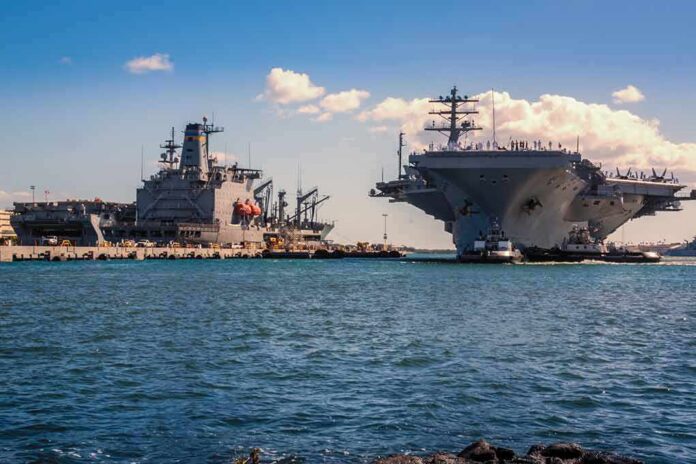
Acting Navy chief Hung Cao reportedly said Iran “blew the hell out of” the U.S. Bahrain base, and the Navy is now weighing its future there.
Story Highlights
- Reports describe extensive damage at Naval Support Activity Bahrain from Iranian strikes.
- Navy leadership signaled the base will not be back to normal soon.
- Imagery analyses point to hits on command and communications nodes.
- U.S. Central Command denied a strike on Fifth Fleet headquarters, and no fatalities were reported.
Navy Reviews Bahrain Footprint After Reported Strike Damage
U.S. Navy leaders are reassessing operations at Naval Support Activity Bahrain after months of Iranian missiles and drones reportedly damaged key facilities between late February and June. A Wall Street Journal investigation said the base’s command headquarters and at least a dozen other buildings were hit, along with two satellite communications terminals, though the military said no one was killed and operations were not significantly affected. The review includes timelines for repairs and options to disperse critical functions.
Navy Times reported that Admiral Daryl Caudle told sailors, “We’re not getting back in there anytime soon,” underscoring the scale of the disruption to normal routines at the installation. That candid assessment matches broader reporting that the service is evaluating where certain missions should be based while repairs proceed. Leadership must balance deterrence, force protection, and logistics while staying ready to patrol chokepoints like the Strait of Hormuz and safeguard shipping lanes vital to global trade.
What Was Hit: Command, Communications, and Support Areas
Investigative coverage points to strikes that reached deeper than warehouses. Analysts said damage included command buildings and satellite communications terminals, the systems that tie ships, aircraft, and regional partners together. An independent imagery write-up described destroyed radar domes, a communications relay, and several damaged warehouses, findings consistent with an enemy trying to blind sensors and disrupt command-and-control links at a critical forward hub. Such hits can slow decision cycles even without mass casualties.
Multiple outlets cited damage estimates in the hundreds of millions, with some reports pegging repair costs around four hundred million dollars. Those figures suggest a heavy lift for engineers and contractors and months of rebuild work to harden nodes and restore redundancy. While exact numbers remain unconfirmed, the range highlights a core problem: precision missiles and drones are cheap for Iran to launch but costly for the United States to counter and repair. That cost imbalance invites more probing attacks unless defenses adapt.
Conflicting Messages, Clear Stakes for Deterrence
U.S. Central Command publicly rejected Iran’s claim that it struck the Fifth Fleet headquarters and said incoming attacks failed, pushing back on the most sweeping boasts from Tehran-linked media. At the same time, mainstream reporting documented visible damage on base and quoted current and former servicemembers about operational friction, even as officials emphasized continuity of missions and the absence of fatalities. That split reflects wartime messaging pressures and classification rules, but sailors and taxpayers deserve straight answers.
Acting Navy chief Hung Cao was quoted as saying Iranian attacks “blew the hell out of” the Bahrain base, and that the Navy is assessing next steps. If that assessment holds, Congress and the Pentagon must align funds, timelines, and a hardened basing plan that reduces single-point failures. For conservatives, the priority is simple: protect American forces, restore deterrence, and stop wasting money patching soft targets. Clear oversight can force faster fixes and real accountability for air defense gaps.
What This Means for U.S. Power in the Gulf
The Bahrain hub supports the Fifth Fleet’s daily work: keeping sea lanes open, checking Iranian aggression, and backing partners against terror groups. Damage to command hubs and communications gear risks slower response times, more strain on crews, and higher insurance and shipping costs that hit American wallets. Navy leaders are now weighing dispersion of sensitive nodes, mobile backups, and improved missile and drone defenses to cut risk and keep pressure on Iran’s networked threat. Strength backed by readiness deters adventurism.
Policy makers should press for three concrete steps. First, surge layered air defense that integrates ship sensors, shore batteries, and counter-drone systems. Second, harden and duplicate command-and-control with buried fiber, shielded nodes, and rapid-swap terminals. Third, impose costs on Iran’s missile supply chains and financiers, using sanctions and targeted interdictions. These are practical moves that defend our people, uphold freedom of navigation, and show that attacks on U.S. bases will fail to change our posture in the region.
Sources:
feedpress.me, navytimes.com, wsj.com, defenseone.com, brown-watch.com, timesofisrael.com