

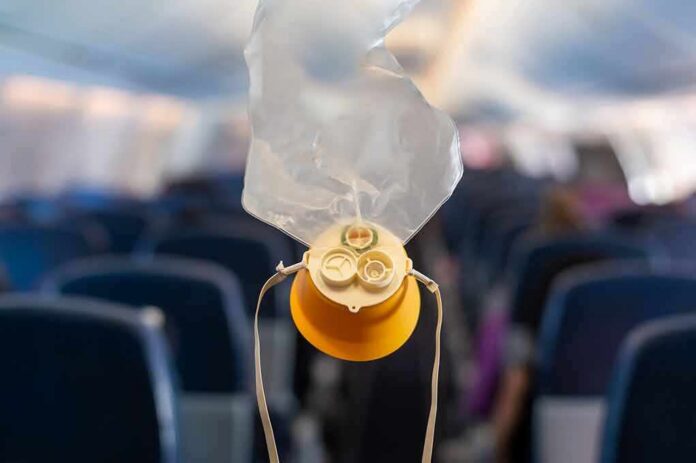
Oxygen masks dropped as a Delta jet dove about 27,000 feet in 10 minutes before landing safely in Las Vegas.
Story Snapshot
- Federal Aviation Administration (FAA) confirmed Delta Flight 2311 diverted to Las Vegas after a pressurization issue.
- Delta said the crew followed training, made an emergency descent, and landed safely with no reported injuries.
- Reports indicate the jet descended from cruise to about 9,000 feet and diverted to Harry Reid International Airport.
- Pressurization events are uncommon and most end safely when crews follow the emergency checklist.
FAA Confirms Safe Diversion After Sudden Pressurization Problem
Federal Aviation Administration officials said Delta Air Lines Flight 2311 diverted safely to Harry Reid International Airport in Las Vegas around 6 p.m. local time on Sunday after the crew reported a pressurization issue. The flight had departed Los Angeles for Salt Lake City before the problem arose. Controllers cleared an emergency descent. The crew brought the jet to a safer altitude and headed for the nearest major airport. No injuries were reported by the airline after landing.
Delta said safety came first and the pilots followed training and procedures to reach optimal altitude as oxygen masks deployed on board. Aviation trackers and media reports said the aircraft descended to about 9,000 feet before landing in Las Vegas. Another outlet reported the plane lost roughly 27,000 feet in about 10 minutes, which fits the standard emergency playbook for cabin pressure problems. After landing, passengers deplaned and were rebooked to continue their trips.
What Passengers Experienced During the Emergency Descent
Passengers saw oxygen masks drop and felt a rapid descent as the plane lowered to denser air. That response is by the book for hypoxia risk, which can set in fast at cruise altitude. The crew’s job is to get the jet down quickly, level off where breathing is safer, and divert to a suitable airport. That is what happened here, according to statements and flight data summaries that match the timeline and actions described.
Emergency descents can feel dramatic, but they are designed to protect everyone on board. The airplane trades altitude for time and safety while crews run checklists. The Federal Aviation Administration describes this process in guidance and training materials used across the industry. The safe landing in Las Vegas, the lack of reported injuries, and the quick handling show those checklists at work on this flight.
How Often Pressurization Failures Occur—and Why the System Works
Pressurization failures are rare compared with total flights, and most end without deaths when crews act fast. A large safety review cataloged hundreds of pressurization events, with only a tiny share leading to the worst outcomes. The key is early recognition and an immediate descent, which greatly lowers the risk to passengers and crew. That is why airlines train for this exact scenario and why masks and checklists exist.
A Delta Air Lines Boeing 737-900 carrying 180 passengers and crew was forced into a dramatic rapid descent after suffering an unexpected pressurization issue over the western United States.
Flight DL2311 was travelling from Los Angeles to Salt Lake City on September 6 when it… pic.twitter.com/EfyAOKKe66
— Flightdrama (@flightdrama) September 10, 2026
In this case, Delta’s report and the Federal Aviation Administration’s confirmation align with that history: quick descent, oxygen masks, and a safe diversion. Media accounts citing trackers pegged the low point near 9,000 feet before landing, again matching standard steps to curb hypoxia risk. An outlet also timed the drop at about 10 minutes from cruise to much lower altitude, which is consistent with an emergency descent profile used by major carriers in modern jets.
What Comes Next: Investigation and Traveler Takeaways
Federal Aviation Administration officials typically review events like this to determine the root cause and to confirm the crew and maintenance actions. That work can take time, and early reports often focus on symptoms, not parts or systems. For travelers, the key takeaway is that the layered safety system—crew training, masks, and descent procedures—functioned as designed on this flight. The outcome in Las Vegas shows the system’s goal: everyone on the ground, safe.
Sources:
independent.co.uk, infobae.com, faa.gov, thetraveler.org, ktnv.com