
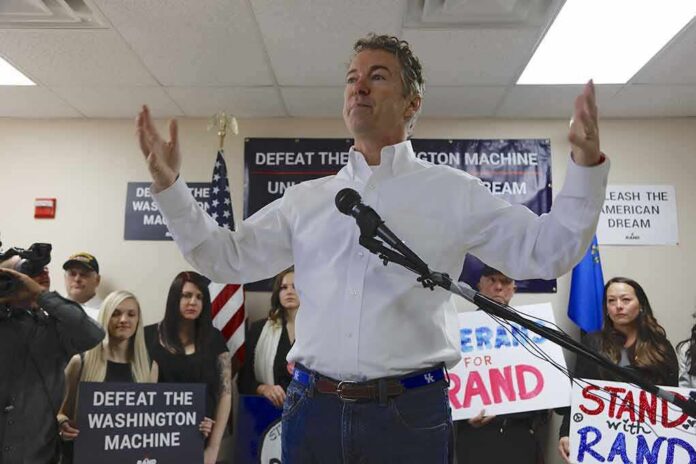
Senator Rand Paul’s clash with Dr. Anthony Fauci turned into a public fight over the Fifth Amendment, contempt, and the legacy of the COVID years.
Quick Take
- Fauci invoked the Fifth Amendment and refused to answer questions at Paul’s hearing.
- Paul said Fauci’s privilege claim was not valid because of the pardon and earlier testimony.
- Fauci said he acted on counsel’s advice and feared his words could be used to prosecute him.
- The committee moved toward a contempt vote after Fauci declined to respond.
Paul Turns the Hearing Into a Fight Over Accountability
Rand Paul used the hearing to press Anthony Fauci for answers and an apology. CBS News and Fox News reported that Paul opened by demanding Fauci say he was sorry, while Politico reported that the chairman made the confrontation part of a long-running feud over COVID-19 policy and pandemic research. The tone was sharp from the start, and Paul made clear he wanted more than a policy defense.
Paul also tied the hearing to recent document releases and old accusations about the pandemic response. The Senate Homeland Security and Governmental Affairs Committee said Paul renewed his referral of Fauci to the Department of Justice after citing newly uncovered records, and committee materials said those records conflicted with Fauci’s past sworn denials about deleting official files. That gave Paul a procedural reason to escalate the fight instead of treating it as a political argument alone.
Fauci Invokes the Fifth Amendment
Fauci did not play along with Paul’s questions. Reuters, PBS, and NBC News reported that Fauci appeared under subpoena and repeatedly invoked his Fifth Amendment right rather than answer. In prepared remarks reported by NBC News and CNN, Fauci said he was acting on the advice of his attorneys and feared Republicans could try to use his testimony to pursue perjury claims. That is the core fact behind Paul’s outrage.
Fauci also gave his own explanation for the refusal. Yahoo News reported that he said Paul’s “unhinged obsession,” along with repeated public attacks and the release of his personal diary, made him think the hearing could be used to trap him into self-incrimination. PBS reported that Paul argued Fauci had no valid privilege because of the blanket pardon and because he had already answered earlier in the hearing. The dispute, at least in public view, became a legal fight over whether that privilege still held.
The Legal and Political Stakes Remain High
The public record shows a real constitutional clash, not just a shouting match. Reuters and Forbes reported that Paul said the pardon did not block contempt, while Forbes also noted that the privilege issue may have to be settled in court. That means Paul’s claim is more than talking points, but it is still a legal argument rather than a final ruling. Fauci’s act of invoking the Fifth is clear; the deeper question is whether the committee or a court will accept that choice.
🇺🇸⚕️🦠Rand Paul Renews Criticism of Fauci Over U.S.-Funded Wuhan Research at Senate Hearing
A heated Senate hearing has reignited one of the most divisive debates of the COVID-19 era, with U.S. Senator Rand Paul sharply criticising former White House chief medical adviser Dr.… pic.twitter.com/ZhWZ6BzVI1
— Real Global News (@FelastoryMedia) July 30, 2026
For conservatives who watched years of lockdowns, heavy-handed public health rules, and elite excuses, the hearing fits a familiar pattern. Paul is using Senate power to force answers about COVID-era decisions, while Fauci is using the Fifth Amendment to avoid sworn answers that could create new exposure. The result is a high-stakes showdown about trust, accountability, and whether the people who shaped the pandemic response will ever answer straight questions in public.
Sources:
youtube.com, pbs.org, cbsnews.com, foxnews.com, politico.com, washingtonpost.com, facebook.com, hsgac.senate.gov