

One Swipe Changed Dating Forever
The same swipe that made dating “easy” also turned commitment into a disposable, screen-driven transaction—and the cultural fallout is now impossible to ignore.
Story Snapshot
- Tinder’s 2012 launch popularized swiping, shifting dating from questionnaires and deliberate matching to rapid, visual decisions.
- Online dating’s roots go back to 1959–1965 computer matchmaking experiments, but smartphones and geolocation made it mainstream.
- Match.com helped commercialize online dating in 1995, while later apps specialized by values, demographics, and lifestyle niches.
- The swipe model drove massive industry growth, pushed consolidation, and influenced “match-style” design across other platforms.
From Punch Cards to Phones: How Tech Gradually Replaced the Matchmaker
Stanford students experimented with computerized matchmaking as early as 1959, using punch cards and an IBM 650 to pair 98 men and women in a school project. Harvard followed in 1965 with Operation Match, charging $3 for questionnaire-based matches and reportedly reaching more than 1 million users during the 1960s. These early systems aimed at compatibility, but the premise was the same: outsourcing a deeply human decision to a machine.
$Match has lead the dating market for over two decades by serving multiple customers segments with very different consumer brands.
Match. Tinder. Hinge.
Facebook’s one size fits all approach won’t work. People want segmentation and the ability to signal through the brand.
— Norgard (@BrianNorgard) September 5, 2019
The modern internet era accelerated in the mid-1990s. Kiss.com appeared in 1994 as a basic profile-and-contact site, while Match.com launched in 1995 and became the first major, widely commercialized online dating platform. That shift mattered: dating moved from local communities and shared institutions—church, neighborhood, workplace—into a marketplace of searchable profiles. Users could filter by age, location, and lifestyle, treating relationships more like consumer choices.
Why 2012 Changed Everything: Swiping Replaced Compatibility as the Default
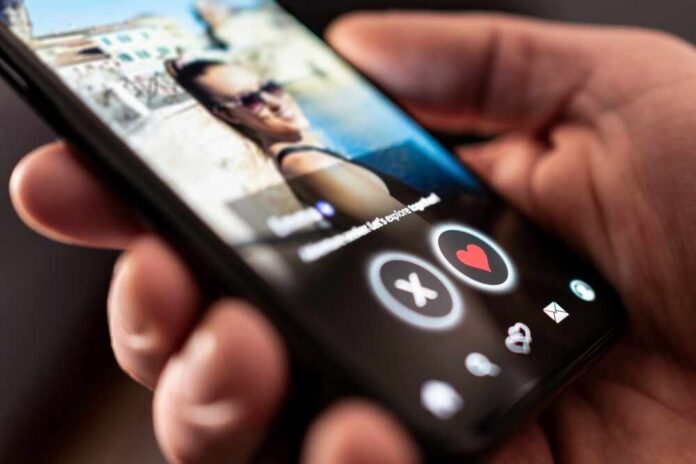
Tinder’s 2012 debut didn’t invent online dating, but it re-engineered the user experience around speed. Instead of lengthy questionnaires and time-consuming searches, the app normalized a simple right/left decision, heavily driven by photos and minimal demographic cues. Tinder also pushed real-time location matching, making dating feel immediate and constant—something you could do anywhere, not a deliberate activity you set aside time for.
The result was a “gamified” interaction loop: quick decisions, instant feedback, and an endless stream of options. That design helped online dating break fully into the mainstream, especially among younger adults, because it felt less formal than older sites. Research cited in the provided materials also notes that Tinder later integrated with Facebook for photos and friend verification, an effort to reduce catfishing and increase trust—though it did not eliminate deception.
Market Power, Consolidation, and the Business of Romance
The swipe era turned dating apps into a major, scalable industry. As swiping became the standard interface, competitors either copied the mechanic or differentiated through niches. Match Group grew into a dominant corporate force through ownership and acquisitions, reflecting a broader pattern of consolidation across tech. Meanwhile, other platforms demonstrated global reach: Badoo, for example, has been reported at hundreds of millions of users with hundreds of thousands of signups per day.
Smartphones made this business model stick. After the iPhone helped bring smartphones to mass audiences, mobile-first dating products could deliver always-on engagement and location-based discovery. Zoosk emerged in 2007 as an early player with mobile app adoption, and Grindr launched in 2009 as a geosocial app using location to show nearby matches. In practical terms, dating shifted from occasional online sessions to persistent, phone-centered participation.
Safety, Family Formation, and the Cultural Tradeoffs of “Endless Options”
Not every consequence of the swipe era is measurable in a single statistic, but the incentives are visible. A system built around rapid judgments and constant availability can discourage patience and seriousness—traits most families depend on for long-term stability. The research also flags safety and equity concerns tied to superficial, rapid-judgment design. Bumble launched in December 2014 with a “women make the first move” model, influenced by experiences of harassment and aimed at changing how power dynamics play out in messaging.
Pew Research Center has documented climbing use of dating apps and sites, reinforcing that this isn’t a niche phenomenon anymore—it’s a normal pathway for meeting partners. For Americans concerned about family formation and social cohesion, that matters because the “how” shapes the “who” and the “why.” When dating becomes a high-volume feed, people can start treating each other as replaceable, and communities lose the stabilizing role they once played in pairing people up.
Sources:
https://www.datingadvice.com/online-dating/history-of-online-dating
https://www.datingnews.com/daters-pulse/timeline-of-how-online-dating-has-changed/
https://www.stylight.com/Magazine/Lifestyle/Love-First-Swipe-Evolution-Online-Dating/
https://www.skadate.com/the-history-of-dating-sites-from-punch-cards-to-swipes/
https://sundial.csun.edu/168529/arts-entertainment/the-evolution-of-online-dating/
https://www.eharmony.com/history-of-online-dating/
https://en.wikipedia.org/wiki/Timeline_of_online_dating
https://news.virginia.edu/content/qa-how-did-online-dating-start