

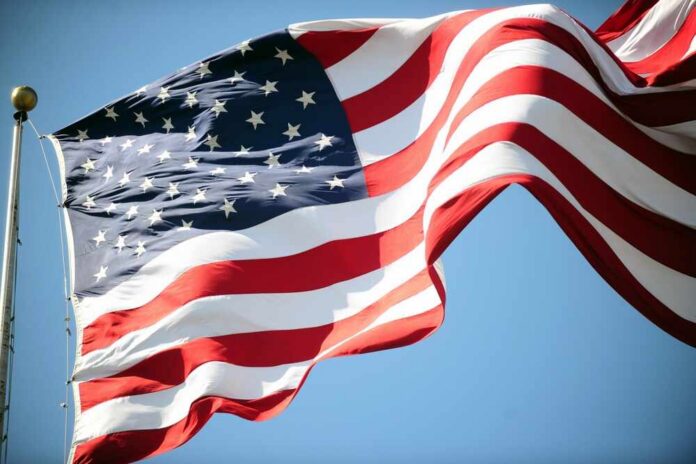
A single sentence in a small-city council meeting turned a park of 27 American flags into the latest national argument over what “belonging” in America is supposed to mean.
Story Snapshot
- Lynnwood, Washington Councilwoman Isabel Mata told colleagues a Pride flag felt “way more relatable” to her than the U.S. flag during a May 4, 2026 meeting.
- The comments centered on Wilcox Park’s “U.S. Flag Park,” a bicentennial-era display featuring 27 flagpoles and historical American flags.
- Residents and veterans blasted the remarks as disrespectful to national symbols and service, and the clip spread quickly through conservative media.
- Mata apologized and later emphasized she meant adding flags “alongside” the American flag, not replacing it, and said any change would require a public process.
Wilcox Park Was Built to Tell a National Story, Not a Partisan One
Wilcox Park’s flagpoles weren’t put up as a political dare. They were installed for America’s bicentennial, and the idea is straightforward: fly historical versions of the U.S. flag to show national continuity through change. That matters because the park functions like a civic memory—simple, visible, and meant to outlive whichever party is having a good year. That’s why debates about “updating” it land like a punch.
The meeting on May 4, 2026 put that civic memory on trial. Mata criticized the 27 American flags as not representative of Lynnwood’s diversity and said they symbolized “parts of American history that, frankly, are not great.” She then shifted from policy to personal identity, saying a Pride flag was “way more relatable” and that she wouldn’t fly the U.S. flag at her home because she “wasn’t even born here,” but would fly a Pride flag.
How a Personal Preference Became a Public Insult in One Breath
Public officials can hold any personal view they want, but they don’t get to pretend their words stay personal when they speak in an official meeting about a public monument. Mata’s phrasing didn’t just elevate a Pride flag; it downgraded the American flag as something alien to her. Even if her intent was to make a point about inclusion, her delivery placed citizenship and gratitude on opposite sides of the table—an ugly frame in a city where many families, including immigrant families, work hard to claim America as home.
Conservative outlets framed the comments as a familiar pattern: progressive politics treating the national symbol as negotiable, contingent, or even embarrassing. That critique resonates because the American flag doesn’t ask your résumé before it represents you. It represents a system of rights and obligations, including the freedom to criticize it. When an elected leader says the flag is unrelatable, many hear a refusal to share the common ground that keeps local government from turning into competing tribes.
The Backlash Wasn’t Just “Outrage”; It Was a Values Check
The response from residents and veterans wasn’t complicated. A park dedicated to the American flag, they argued, should not be framed as a problem to solve. For veterans especially, the flag can feel less like a “symbol” and more like a receipt—proof that sacrifice was made for a nation, not a collection of identity subgroups. American conservative common sense starts here: civic unity comes first, and every other banner is optional, private, and secondary to the country that protects the right to fly it.
Social media accelerated the fight the way it always does: a few clipped moments, a few hot captions, and suddenly Lynnwood’s city council meeting played like a national referendum. That dynamic rewards maximalism. Supporters of Mata could interpret her as challenging exclusion; critics could interpret her as rejecting the country. When attention is the currency, nuance is the first thing sold off. The irony is that Wilcox Park’s flag display exists to teach historical nuance, yet the argument around it quickly became all-or-nothing.
The Apology Tried to Close the Loop, But the Question Stayed Open
Mata apologized after the backlash and later clarified that she believed there was room for other flags “alongside the American flag, not instead of it,” stressing a public process for any changes. That walk-back mattered, but it didn’t fully erase the original message because the most memorable part wasn’t a policy proposal. It was the value statement: Pride felt more relatable than the American flag. People don’t forget value statements from elected officials, because they hint at how future decisions will be framed.
The Lynnwood Times also pushed back on a specific claim that fed the controversy: Mata suggested the city’s “all are welcome” logo was rainbow-colored, and the local reporting corrected that. That kind of detail seems small until you realize how these disputes grow. Flag fights thrive on symbolism piled on symbolism. If the factual foundation is sloppy, opponents assume the motive is ideological. If the motive is ideological, the public assumes the next step is policy. Trust erodes fast when precision disappears.
What This Episode Signals for the Next Wave of “Flag Wars”
No formal policy change had occurred as of the research cutoff, and the flags at Wilcox Park remained. That may sound like the story ended, but it’s more like the opening scene. Municipal fights over flags rarely stay local because they touch national nerves: patriotism, cultural power, and the definition of “we.” A practical conservative approach would keep the American flag as the unifying centerpiece on public property, while leaving other expressions to clearly designated contexts that don’t redefine a civic landmark by committee.
Leftist Washington Councilwoman praises Pride flag over American flag | American Agendahttps://t.co/jQwfQF5YgQ
— ConspiracyDailyUpdat (@conspiracydup) May 8, 2026
The deeper lesson is for voters, not just councilmembers. Local government is where national ideology gets translated into the everyday—parks, signs, ceremonies, and the small rituals that teach kids what community is. When an official treats the American flag as unrelatable, the public has every right to ask: If the shared symbol doesn’t bind us, what does? The next election, the next council agenda item, and the next “small” controversy will answer that.
Sources:
Lynnwood City Councilwoman apologizes after criticizing American flags at Wilcox Park