

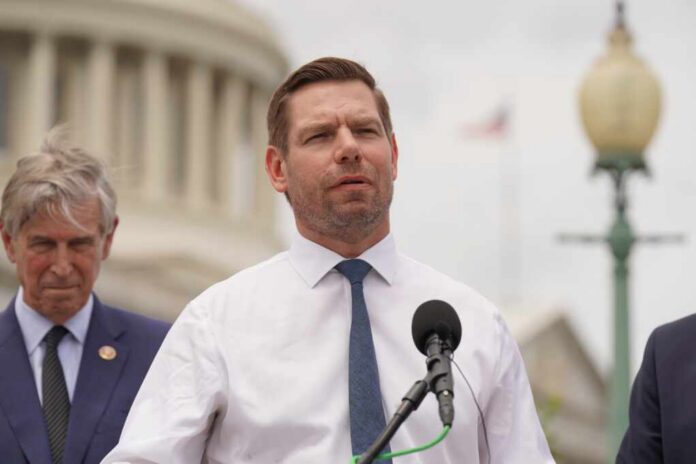
The same federal power conservatives feared would be weaponized under Democrats is now being tested under a Trump-led FBI—right as California’s next governor race heats up.
Quick Take
- FBI Director Kash Patel is reportedly directing the release of redacted files from a decade-old FBI inquiry tied to Eric Swalwell’s past contacts with Christine Fang, a suspected Chinese intelligence operative.
- Swalwell says the move is a Trump-ordered “smear” meant to affect California’s June 2, 2026, open primary, and his lawyers sent Patel a cease-and-desist warning of legal liability.
- Multiple reports say the old investigation produced no criminal charges, and Swalwell cut ties after a 2015 intelligence briefing.
- The dispute is fueling a broader fight over transparency versus politicization—especially when closed cases are revived near elections.
Patel’s reported directive revives an old China-influence story
Reports say FBI Director Kash Patel has instructed the bureau’s San Francisco field office to prepare redacted records for public release from an investigation involving Rep. Eric Swalwell and Christine Fang—also known as “Fang Fang”—a figure described as a suspected Chinese intelligence operative. The underlying events date back to the 2014 election cycle, when Fang volunteered and helped fundraise, and to 2015, when Swalwell cut ties after being briefed.
According to reporting, the FBI inquiry itself is years old and ended without criminal charges. That distinction matters: releasing files from a closed, no-charge matter is unusual and raises questions about what the public is being asked to conclude. If the documents show legitimate counterintelligence concerns, transparency helps voters. If they simply repackage old, unresolved suspicions, the timing risks turning national security into campaign-season theater.
Swalwell counters with a legal warning and an election-interference claim
Swalwell has responded with a courthouse news conference in San Francisco, backed by union supporters, and with a cease-and-desist letter to Patel. He argues the release effort is designed to damage him ahead of California’s June 2, 2026, top-two primary, where the highest vote-getters advance regardless of party. He also says he has not been contacted recently by the FBI and that the matter is closed.
Democratic allies are reinforcing that argument in blunt terms. Sen. Adam Schiff, who has endorsed Swalwell, has characterized the reported file-release push as “weaponization” of the FBI. The White House, FBI, and DOJ offered no immediate public comment in the cited reporting, leaving a vacuum where each side can frame the same act—declassification—as either overdue sunlight or selective political punishment.
What conservatives should watch: rule-of-law standards, not team jerseys
Conservative voters have spent years warning that federal agencies can be bent into political tools, undermining equal justice and public trust. That principle does not change based on which party controls the executive branch. A core question is process: What is the bureau’s standard for releasing investigative material in a closed case with no charges, and is that standard being applied consistently across political figures and across elections?
Transparency can be good—if it is consistent and protects due process
China’s influence operations are real and serious, and the public has a legitimate interest in how U.S. officials respond when suspected foreign operatives target political circles. At the same time, Americans also have a constitutional interest in due process, the presumption of innocence, and limits on state power. If file releases become a tool to imply wrongdoing where prosecutors never alleged a crime, that practice can erode trust in law enforcement.
For California voters, the practical reality is that the headlines themselves can shape an election even before any documents are released. For national conservatives, the bigger stake is whether the FBI sets a precedent of re-litigating old, closed matters near campaign deadlines. Without a clear, neutral policy explained to the public, the bureau risks looking political no matter which party is in charge—and that is a long-term problem for constitutional government.
Sources:
FBI Director reportedly pushes to release files probe of Eric Swalwell