

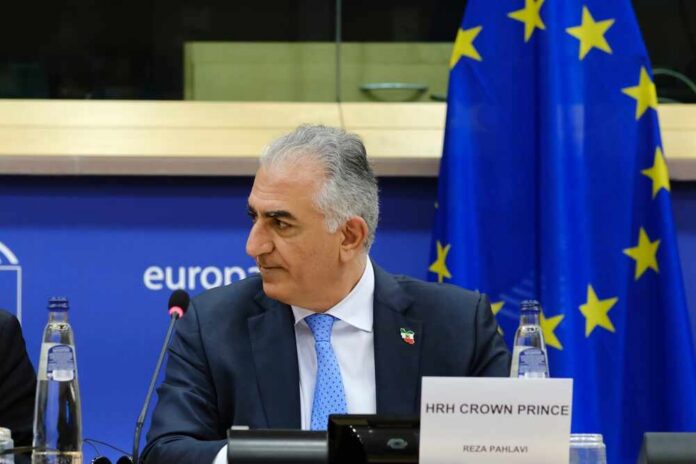
Reza Pahlavi’s blunt message—“Iran is not the Islamic Republic”—is gaining traction as pressure mounts on Tehran’s enforcers and a post-regime transition plan is put on the table.
Quick Take
- Exiled Crown Prince Reza Pahlavi is urging Iranians to separate their national identity from the ruling theocracy and prepare for a democratic transition.
- Pahlavi says the regime is weakening as Iran’s security apparatus faces external strikes, internal dissent, and rising calls for defections.
- He is promoting a “Prosperity Project” framework aimed at stabilizing governance and rebuilding key sectors after any collapse.
- Major unknowns remain, including the true scale of underground organizing and whether Iranians ultimately want any return to monarchy-style leadership.
Pahlavi’s “Iran Is Not the Regime” Argument Moves Center Stage
Reza Pahlavi, the son of Iran’s last shah, is using a simple refrain—“Iran is not the Islamic Republic”—to frame the current showdown as a fight for national self-rule, not a factional dispute. From exile, he has called for the regime’s collapse and has described an approaching “final call” moment for coordinated public action. His stated goal is a secular, democratic outcome decided at the ballot box, not by clerics or militias.
Pahlavi’s public messaging also stresses unity across Iran’s ethnic and religious lines, coupled with explicit commitments to equal rights after the Islamic Republic. That emphasis matters because Tehran has historically exploited internal divisions to maintain control. Pahlavi’s pitch is that a post-regime Iran can keep its territorial integrity and cultural identity while replacing the ideological state with constitutional governance. He has also signaled readiness to return to Iran, even as the security environment remains volatile.
Pressure on IRGC and Basij Is Driving Defection Politics
Recent reporting tied to Pahlavi’s statements describes a regime under strain, with the IRGC and Basij—core instruments of domestic repression—portrayed as weakened by military action and broader isolation. Pahlavi has directly appealed to Iran’s military, police, and state employees to defect or stand aside, arguing that a transition can preserve order if personnel who are not “blood-stained” help prevent chaos. That approach prioritizes continuity of basic services over revolutionary purges.
For Americans watching from afar, the takeaway is strategic: if defections increase, the regime’s coercive capacity can degrade quickly, reducing its ability to suppress mass protests. It also highlights a major limitation: several claims about organized internal sabotage networks are difficult to independently verify from open sources. That doesn’t disprove the claims, but it means observers should separate confirmed events from aspirational messaging designed to encourage momentum and fear inside the regime.
The “Prosperity Project” Tries to Answer the Hard Question: What Comes Next?
Iranian opposition movements often surge on anger and bravery, then fracture over what replaces the old system. Pahlavi is attempting to preempt that failure mode by promoting a “Prosperity Project,” described as a structured plan drawing on experts across disciplines—law, economics, health, and education—to prepare governance proposals for a post-Islamic Republic state. The concept is designed to reassure Iranians and international partners that a transition would not be improvised in real time.
That planning focus also intersects with a core conservative concern: stability without globalist “nation-building” fantasies. The sources describe a framework that aims for Iranian-led rebuilding rather than a permanent external administration. Still, the research does not provide full operational details—such as enforcement mechanisms, timelines, or who would control security institutions on day one—so readers should treat the Prosperity Project as a political blueprint, not a finalized constitutional package.
Where the Trump Era Fits—and What Remains Unclear
Pahlavi’s storyline links the regime’s vulnerability to military pressure and shifting geopolitical realities, including U.S. posture under President Trump. Some commentary and interviews cite encouragement from U.S. figures and highlight the perceived impact of strikes on regime confidence. At the same time, other analysis flags a live debate: many Iranians may rally around Pahlavi as a unifying symbol while still rejecting any restoration of monarchy. Pahlavi has repeatedly pointed back to referendums as the legitimizing mechanism.
Crown Prince Pahlavi: ‘Iran Is Not the Islamic Republic’https://t.co/PKTkCvHGEv
— PJ Media (@PJMedia_com) March 22, 2026
The immediate policy relevance for the U.S. is that a collapsing theocracy could reshape the Middle East’s security landscape, including terrorism financing, missile proliferation, and hostage diplomacy. But the research also warns against overstating certainty: the true scale of protests, the durability of security-force loyalty, and the existence and capacity of clandestine networks are not fully measurable from the outside. Conservatives can appreciate the clarity of “maximum pressure” logic while still demanding verifiable benchmarks.
Sources:
Iranian Crown Prince Reza Pahlavi says ‘final call’ for regime
Prince Reza Pahlavi vows equal rights after fall of Islamic Republic
Iranian Crown Prince Reza Pahlavi announces readiness lead Iran’s post-regime transition
Prince Reza Pahlavi: The Islamic Republic Is Drawing Its ‘Final Breaths’
Iran after the Islamic Republic