
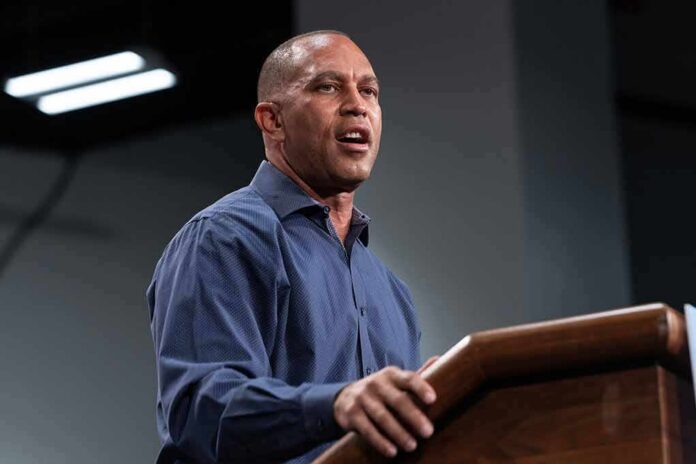
House Democratic leader Hakeem Jeffries and liberal Israel lobby J Street joined forces to defeat an amendment that would have shut off $3.3 billion in U.S. military aid to Israel, even after J Street’s own president publicly said Israel is committing genocide in Gaza.
Story Snapshot
- Jeffries led Democrats against a Thomas Massie amendment to end $3.3 billion in U.S. military aid to Israel.
- Jeffries and J Street used the same “overly broad” talking point to argue the amendment would harm other programs.
- J Street backed Jeffries’ move, despite its president recently saying Israel is committing genocide in Gaza.
- More than 100 Democrats still voted to cut aid, exposing a deep split inside the party on Israel.
Jeffries Moves to Block Amendment Cutting Israel Military Aid
House Democratic leader Hakeem Jeffries told fellow Democrats he would vote against Kentucky Republican Thomas Massie’s amendment to eliminate about $3.3 billion in U.S. military funding for Israel. The amendment was offered to the State Department and foreign operations funding bill, giving lawmakers a rare clear vote on whether to continue arming Israel’s war machine. Reports say Jeffries informed his caucus of his decision in a “Dear Colleague” letter circulated shortly before the floor vote.
Jeffries argued in that letter that the amendment was “overly broad” and would reach far beyond weapons transfers. He warned Democrats that the language could hit humanitarian aid, refugee programs, peace-building work, and even U.S. embassy operations tied to the same funding accounts. Jeffries also claimed the cut would weaken America’s ability to confront Hamas, Hezbollah, and other terrorist groups in the region, framing the vote as a question of national and Israeli security rather than just Israel policy.
J Street Echoes Jeffries and Backs His Opposition
Liberal Israel lobby J Street came out the same day with a statement using almost identical language, calling the Massie amendment “overly broad and poorly drafted.” J Street president Jeremy Ben-Ami said the measure was a “political stunt” meant to divide Democrats, not a serious plan to change U.S. policy or end the war. In that statement, J Street explicitly said it supported Jeffries’ decision to vote no, while also stressing that some members might still use the amendment to signal opposition to Israel’s conduct.
News coverage of Jeffries’ letter noted that he cited “pro-peace organizations like J Street” as part of the public rationale for his stance. This showed that Jeffries was leaning on J Street’s position to reassure nervous Democrats who wanted guidance on how to navigate the vote. At the same time, J Street’s support for Jeffries carried extra weight because Jeffries had only recently accepted the group’s endorsement after years of aligning more closely with traditional pro-Israel outfits.
Genocide Admission Raises Hard Questions About Continued Arms
The alliance between Jeffries and J Street is striking because J Street’s own president, Jeremy Ben-Ami, has now said he is convinced Israel is committing genocide in Gaza. According to reporting, Ben-Ami previously pushed back on that label but later acknowledged the scale of destruction met the legal and moral definition of genocide. Yet even after that shift, J Street joined Jeffries in opposing a measure that would have stopped billions in U.S. weapons and military support flowing to the same Israeli government.
Critics on the left seized on this contradiction, arguing that Jeffries and J Street were helping “arm genocide” by blocking the only live amendment aimed at ending U.S. military aid. Commentary pointed out that Jeffries and J Street used their shared “overly broad” message to protect the aid pipeline while presenting themselves as concerned about humanitarian and diplomatic side effects. For many activists, that claim sounded hollow, since the package at issue was overwhelmingly military and security assistance rather than food or medicine.
Democratic Split and Limits of the ‘Overly Broad’ Argument
The Massie amendment still drew significant support from inside the Democratic Party, with more than 100 Democrats voting for it or not voting, even as it failed 314–104. That vote count showed a serious internal divide: nearly half of House Democrats were willing to be on record for cutting off military aid to Israel, despite pressure from their own leadership. At the same time, Jeffries chose not to whip the vote, telling members to vote their conscience while personally opposing the measure.
Supporters of Jeffries and J Street say the amendment lacked carveouts and could have accidentally captured nonmilitary programs, which is a recurring concern in funding fights. However, public reporting has not yet provided the full amendment text or a detailed budget analysis that proves humanitarian aid, refugee resettlement, or embassy security would have been cut. Jeffries’ warnings about harm to counterterror efforts and diplomacy remain policy arguments based on broad funding categories, not documented examples of specific programs losing money.
Broader Pattern in Foreign-Aid Battles
This fight fits a larger pattern in Washington, where lawmakers use foreign-aid amendments to force hard votes on Israel policy and the Gaza war. Progressives often back these measures to take a stand against what they see as human rights abuses, while party leaders and pro-Israel groups oppose them by pointing to security risks and drafting flaws. The result is that the same amendment becomes a moral marker for one side and a “reckless” cut for the other, deepening mistrust between the Democratic base and its leadership.
For constitutional conservatives watching from the outside, the story shows how powerful lobby groups and party leaders can still steer billions in foreign military aid through Congress, even when their own allies admit grave abuses. While President Trump’s administration now sets the broader foreign policy direction, these House battles highlight how entrenched Democratic leadership and their preferred advocacy partners, like J Street, work to keep the money flowing and shut down efforts to use the power of the purse to stop it.
Sources:
original.antiwar.com, nytimes.com, newrepublic.com, chicagotribune.com, facebook.com, alaska-native-news.com, jstreet.org, commondreams.org, newsmax.com, yahoo.com, instagram.com