
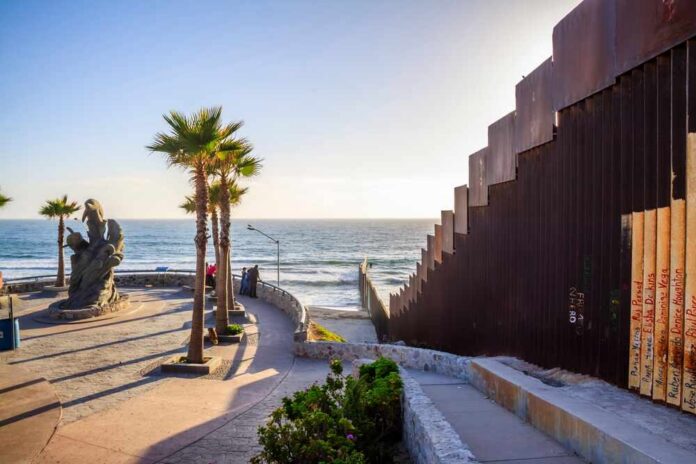
A new stretch of border wall is rising along a cartel corridor near Tijuana, and the fight over whether it protects children or wildlife is already in full swing.
Story Snapshot
- New wall construction is underway in key San Diego–Tijuana corridors long used by smugglers and traffickers.
- Federal data and border agents say barriers cut illegal crossings and smuggling in some high-traffic zones.
- Environmental groups warn the California projects slice through fragile wildlife corridors and public lands.
- Evidence on child trafficking at this hotspot is real but hard to measure, and both sides use that gap to push their narrative.
New Border Wall Rises Over A Known Smuggling Corridor
New border wall construction has restarted near San Diego, including areas around San Ysidro, Otay Mesa, Jacumba, and Smuggler’s Gulch, using earlier funds and fast-track powers from the Department of Homeland Security (DHS).[2] DHS issued waivers in 2025 so crews could move faster through this tough terrain, which sits right across from eastern Tijuana, a long-time hub for cartels and migrant flows.[1] These projects close remaining gaps where people, drugs, and weapons have slipped through for years.[6]
Law enforcement and researchers agree this corridor has been heavily used by smugglers, including those tied to human trafficking. Mexican federal authorities and the navy uncovered a roughly 870-foot cross-border tunnel near Otay Mesa that had lights and other equipment, and United States Homeland Security investigators took part in the case. That tunnel, along with years of patrols and seizures, shows cartels are willing to invest serious money to move people and product under or around any barrier in this zone.
Do Walls Work Against Trafficking, Or Just Move It?
Supporters of the new construction point to Department of Homeland Security data showing that new barriers have cut illegal entries and reduced manpower needs in at least one area of the border.[3] United States Border Patrol videos from the region stress that walls channel crossings into fewer, more controlled points, making it harder for cartels to slip large groups or loads through at once.[5] For many agents on the ground, the wall is one key tool, not a magic fix, but better than leaving open lanes at a known hotspot.
Critics, including some academics and advocacy groups, counter that fencing often shifts migration and smuggling instead of stopping it. A peer-reviewed “hot-spot” analysis of fencing tied to the Secure Fences Act in Arizona found that new barriers pushed crossings into more remote areas and raised the chance that migrants would die, rather than removing the danger altogether.[4] In this view, traffickers and smugglers look for the weakest link, so a wall near Tijuana may simply push them east or into more tunnels, rather than ending their business.
Child Trafficking Claims Meet Thin Public Data
Conservatives often hear that this California wall segment sits near a “child trafficking hotspot,” and there is no question cartels have kidnapped children, women, and men into sexual and labor slavery along the southern border.[1] Yet the public record for this specific San Diego–Tijuana corridor is thinner than many expect. Available sources do not show clear before-and-after numbers on rescued victims, prosecutions, or hotline calls tied to the exact wall segments now under construction.[1] That makes it hard to prove, with data alone, that this wall has already cut child trafficking.
This does not mean the threat is fake. It means most detailed evidence is locked inside agency files on both sides of the border. United States Customs and Border Protection, the Department of Homeland Security, Homeland Security Investigations, Mexican federal authorities, and the Mexican National Guard all hold pieces of the picture.[1] Without shared records on kidnappings, extortion, and trafficking cases in these neighborhoods, public debate often leans on personal accounts, media tours, and political framing more than hard numbers.
Mexican Forces, Security ‘Stage Shows,’ And Real Patrols
Field reporting from outlets embedded with security forces in Tijuana describes frequent patrols by the Mexican military and National Guard in the same corridor, with checkpoints aimed at blocking smuggling of people, drugs, and guns. Reporters saw coordination with United States Border Patrol and even Marines, including shared radio channels to track movements along the fence line. Officials on both sides told them that the new wall segments, plus this security surge, were changing cartel patterns in nearby neighborhoods.
BORDER WALL NEAR CHILD TRAFFICKING HOT SPOT
"They trafficked children, they trafficked women, and they trafficked men." A once-open gap near the California-Mexico border that @OscarRamirezTJ says was exploited by cartels and human traffickers has now been closed with new border… pic.twitter.com/gjrpk7Xlb0
— Real America's Voice (RAV) (@RealAmVoice) June 12, 2026
The same reporters also warned that some of what they saw felt like a “propaganda tour” or “stage show,” where authorities showed off certain successes but did not open up their full records. That raises a fair concern for readers who want proof, not just talking points. It suggests the operations are real but the public view is curated. For citizens, the key is to support strong border tools like walls and patrols while also pressing both governments for real transparency on what is working and what is not.
Environmental Groups Try To Reframe The Story
While many conservatives focus on trafficking and public safety, environmental groups highlight a very different picture of the same projects. Sky Island Alliance says the new wall is cutting through the “Sky Islands” region and severing wildlife corridors and borderland communities, pointing directly to the April 8, 2025 waiver that sped work in Jacumba, Otay Mesa, and Smuggler’s Gulch.[1] Their message is simple: this is not just about migrants and cartels, but also about long-term damage to shared lands.
Wildlands Network and Defenders of Wildlife warn that California wall work through the Otay Mountains and Jacumba Wilderness could eliminate remaining paths for animal movement and threaten dozens of endangered and migratory species.[6] They argue that construction sites, access roads, and noise harm more than just views, and they frame every new segment as a strike against nature, tribal lands, and sacred sites. This constant messaging shapes how many Americans, especially in the media and on the left, understand border security fights before they ever hear from a Border Patrol agent or trafficking survivor.
What Conservatives Should Watch Next
For constitutional conservatives, the core issue is still basic: a sovereign nation must control its borders to protect families from cartels that kidnap and traffic children. The San Diego–Tijuana corridor is a clear test case, because new wall segments, Mexican patrols, tunnels, and shifting routes are all in play at once. The evidence so far says barriers can cut illegal entries in some spots and force cartels to work harder, but it also shows determined criminals dig under, go around, or move to the next weak point.[3]
The next fight will not just be over concrete and steel. It will be over records, numbers, and who controls the story. Conservatives who back strong borders can push for more wall where agents say it helps, demand honest data on trafficking and tunnel cases in this corridor, and challenge attempts to bury security gains under claims of “environmental harm” alone. The children at risk near this hotspot deserve real protection, not another round of political theater.
Sources:
[1] YouTube – BORDER WALL NEAR CHILD TRAFFICKING HOT SPOT
[2] Web – U.S.-Mexico Border Wall – Sky Island Alliance
[3] Web – Border Wall Construction Restarts in California and Texas – ENR
[5] Web – A Hot-Spot Analysis of the Impact of the Secure Fences Act in Arizona
[6] YouTube – Border wall construction resumes