
Trump’s market reassurance landed in the middle of a tariff-fueled selloff, and the real fight is whether confidence can outrun the numbers.
Quick Take
- Trump publicly told markets things were “going very well” and said stocks and the country would “boom.”
- A later reassurance, “it will all be fine,” was followed by a sharp intraday rally in major indexes.
- The reporting provided here ties the market turmoil to tariffs and trade policy, not to a clear labor-market collapse.
Trump’s Reassurance Message
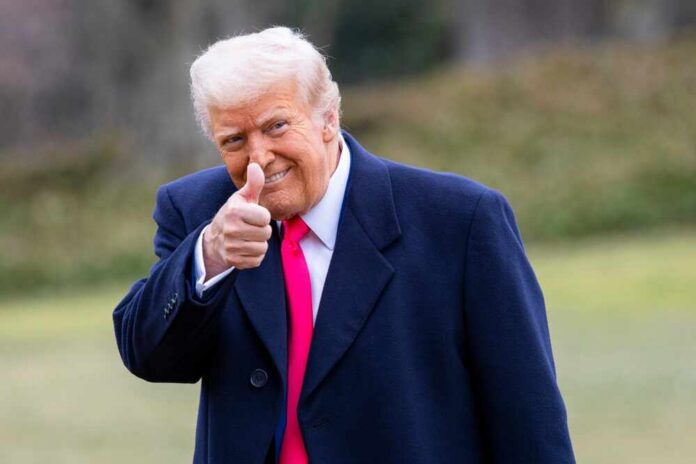
Trump framed the selloff as a temporary scare rather than a sign of deeper trouble, saying he thought things were “going very well” and predicting that “the markets are going to boom, the stock is going to boom, the country is going to boom.” The televised remarks in the research package show a president trying to project strength after a rough stretch for equities, while also linking market confidence to a broader story of national economic momentum.[2]
That approach mattered because Trump’s later reassurance used unmistakably calming language. Fortune reported that after he said “it will all be fine,” the Dow jumped 413 points in five minutes, while the S&P 500 rose 1.1 percent and the Nasdaq gained 1.3 percent.[1] That does not prove the economy was healthy, but it does show that his comments could still move sentiment fast when traders were already on edge.
What Drove the Selloff
The stronger counterargument in the material is that the market weakness was tied to policy risk, especially tariffs and trade uncertainty. The supplied coverage describes a market reacting to Trump’s tariff actions and to a lack of clarity in trade talks, including reports of a third straight day of decline and a one-day drop of roughly 12 percent. In other words, the market reaction was not happening in a vacuum.
That distinction matters for readers who want the plain truth. A stock bounce after reassuring language can reflect a short-term confidence trade, but it does not erase the underlying reason for the panic. The sources here repeatedly point to tariff shock, trade confrontation, and investor concern over policy direction. For households already squeezed by inflation and higher costs, volatility created by Washington is not a small issue; it is exactly the kind of avoidable disruption that drains retirement accounts and business confidence.
What the Record Does Not Show
The research package does not include a primary labor-market release proving that jobs were surging when Trump tried to reassure investors. It contains market commentary, televised remarks, and reactions to tariffs, but not a Bureau of Labor Statistics report, payroll table, unemployment update, or wage data set that would directly validate an “it’s raining jobs” claim.[1][2] Without that evidence, the strongest statement available is that Trump was trying to calm markets, not that the labor market had already vindicated him.
😌 Trump delivers a simple message to markets: "Just relax, everything will work out in the end – it always does."
The comment comes as investors continue navigating geopolitical tensions, economic uncertainty, and market volatility
Whether it's reassurance or optimism, the… pic.twitter.com/iCzxvUZMu5
— ALDERAMIN (@alderamincrypto) June 2, 2026
The broader lesson is simple: markets can rise on confidence, but confidence alone is not the same thing as fundamentals. The record here shows a president selling optimism while investors were reacting to tariff-driven instability and trade uncertainty.[1] For conservatives frustrated by the damage caused by reckless policy swings, the issue is not whether one speech can spark a bounce; it is whether the administration will stop creating conditions that force Americans to watch their savings get tossed around by Washington.
Sources:
[1] Web – Trump Feverishly Tries To Reassure Markets After Stocks Plummet: ‘IT’S …
[2] Web – Dow jumps 413 points in 5 minutes as Trump reassures markets ‘it …