

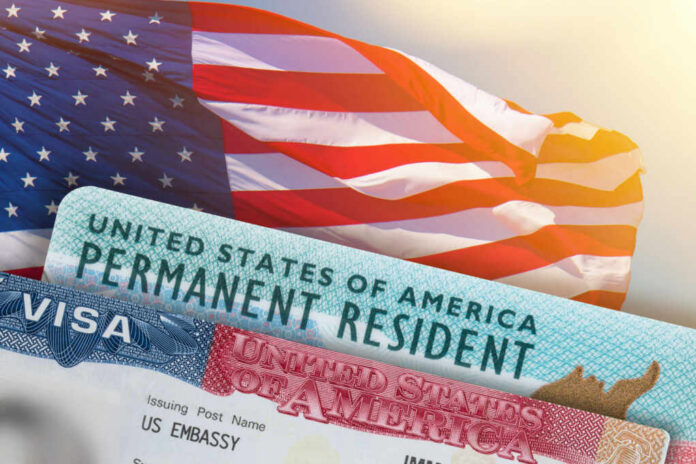
A sweeping shift in green card processing could force many foreign nationals to leave the country mid-application—supporters call it restoring the rule of law, critics call it disruptive to families and jobs.
Story Snapshot
- The Department of Homeland Security move channels applicants from in-country adjustment to consular processing, with limited exceptions for “extraordinary circumstances.” [5]
- The White House frames the change as enforcing the law consistently and restoring operational control at the border. [7]
- Immigration advocates warn a large number of people in the queue could be affected over months or years. [5]
- A parallel registration requirement expands data collection and compliance checks before proof-of-registration is issued. [1]
What The Policy Does And Why It Matters
Scripps News reported that a Department of Homeland Security memorandum directs many applicants seeking permanent residence to complete processing abroad, reversing the common pathway of adjusting status inside the United States, while allowing exceptions for “extraordinary circumstances.” The White House describes the broader immigration posture as restoring operational control and applying the law consistently across cases. The administration presents this as aligning with statutory purpose and improving compliance during adjudications. [5] [7]
The National Immigration Law Center states the administration also launched a registration system that requires creating an online account, submitting biographic details on Form G-325R, and completing fingerprints, photographs, and a signature, after which the government issues a proof-of-registration document following background checks. That mechanism signals an enforcement architecture designed to verify identity, confirm eligibility, and monitor compliance rather than a purely discretionary screening. [1]
How Many People Could Be Affected
Scripps News cites an immigration attorney’s estimate that roughly 600,000 individuals were in the green card pipeline in fiscal year 2023, suggesting many could face consular processing timelines of months or years if routed abroad by default. While that is not an official government dataset, it illustrates the potential operational scale and the practical stakes for workers and families who have arranged their lives around in-country processing norms. The memo’s exception language could narrow impact, but criteria details remain limited publicly. [5]
The administration’s border page argues that illegal crossings declined as resources were redirected to enforcement and removals accelerated, presenting the policy within an enforcement-first framework. That broader narrative supports the government’s claim that tightening procedures can deter misuse and promote compliance. However, the current record supplied does not include the Federal Register text, regulatory impact analysis, or quantified agency findings specifically tying in-country adjustment to fraud or noncompliance at measurable rates. [7]
Supporters’ Case: Lawful Order And Compliance
Supporters point to the administration’s language about returning to the original intent of immigration law, consistent application, and prioritizing removals as part of a comprehensive approach to border integrity. They argue that requiring some applicants to finish processing abroad reduces incentives to overstay or game timelines, and that expanded registration and background checks strengthen screening. Those points track with the White House’s stated priorities, though they rely heavily on administration messaging rather than independent empirical validation. [7] [1]
The registration program’s concrete steps—identity verification, biometrics, and issuance of a proof-of-registration after checks—demonstrate a defined administrative mechanism rather than a vague threat. As described by the National Immigration Law Center, the process builds a traceable record that can support enforcement and adjudication decisions. From a rule-of-law perspective, that infrastructure can reassure citizens that the system is not being exploited and that applicants face uniform standards. [1]
Critics’ Case: Disruption, Delay, And Uncertainty
Critics highlighted by Scripps News argue that shifting applicants abroad departs from long-standing practice and risks family separation, job loss, and prolonged uncertainty, especially for those already settled in communities. They stress that “extraordinary circumstances” exceptions sound narrow and undefined publicly, making relief unpredictable. They also emphasize the absence, so far, of a published administrative record quantifying how many must depart, average wait times abroad, or demonstrated fraud reductions tied to the change. [5]
Trump order Africans, others in US to apply for green cards from home countries
Thousands of Africans and other foreign nationals living in the United States could be forced to leave the country to complete their green card applications following a new immigration .. pic.twitter.com/9KiHVylV6h
— African Telescope News (@Ntelescopenews) May 23, 2026
Advocacy groups point to the added registration burden—account creation, detailed forms, biometrics, and background checks—as evidence the administration is expanding surveillance and removal exposure during processing. That claim underscores a perceived shift from customer service toward enforcement leverage. Yet these sources are advocacy summaries, not the operative regulatory text, and do not on their own resolve whether the exceptions will meaningfully limit disruption in practice or how agencies will manage humanitarian or economic hardship. [1]
What Conservative Readers Should Watch Next
Conservatives who want a lawful, orderly system should look for the Department of Homeland Security’s full memo and any Federal Register publication that specifies covered categories, timelines, and exception standards. Key accountability markers include transparent criteria for “extraordinary circumstances,” adjudicator guidance, and data on how many applicants are routed abroad, how long they remain outside the country, and whether compliance measurably improves. Clear records will determine if this reform delivers security and fairness without unnecessary collateral harm. [5]
Sources:
[1] Web – FAQ: The Trump Immigration Registration Requirement – NILC
[5] YouTube – Trump administration rolls out major change to green card process
[7] Web – Secure the Border – The White House