
Cartels are turning everyday drones into low-cost “air power” on America’s doorstep—while governments argue over who’s really in charge.
Quick Take
- Mexican cartels in Baja California are using drones not just to scout, but to strike police and government targets with improvised explosives.
- A recent multi-drone attack on a Tijuana police station underscores how easily cartel tech can slip past traditional security.
- U.S. surveillance flights near Mexico reportedly surged in early 2026, reflecting growing concern about cartel capabilities and spillover risk.
- “Narco-banners” threatening Americans in Los Cabos spread online, but local authorities say many such threats are unverified—showing how intimidation can work even without proof.
Drones Move From Smuggling Tool to Weapon Over Tijuana
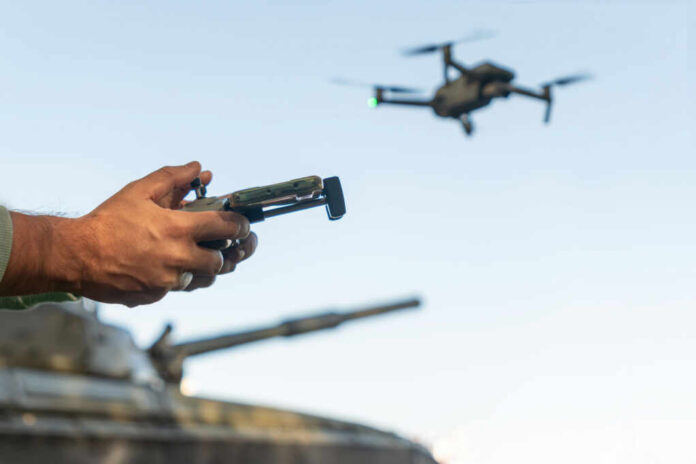
Authorities in Baja California have confirmed cartel-linked drone attacks that look less like improvised stunts and more like a repeatable tactic. Reports describe an October 2026 strike on a Tijuana police station involving three drones carrying explosives packed with nails and metal fragments, damaging vehicles and demonstrating precision intimidation. A prior October 2025 incident attributed to CJNG used a drone-borne explosive against the state prosecutor’s office compound, exposing vulnerabilities even at “heavily protected” sites.
Analysts tracking cartel adaptation have warned for years that drones would move from reconnaissance and contraband delivery toward weaponization. The Baja incidents match that trajectory: drones can hover, observe, and attack while operators stay distant, complicating arrests and deterrence. For local police and prosecutors, the message is direct—physical security hardening matters less if adversaries can bypass perimeters from above. For border communities north of Mexico, the same skills can migrate quickly.
Surveillance, Spyware Fears, and Control Without Checkpoints
Cartel power has never relied only on gunmen; it relies on information. In rural parts of Baja California, reporting describes fears that spyware such as Pegasus has compromised communications, making residents reluctant to speak openly—even on encrypted apps—about criminal activity. Whether every fear is accurate is difficult to verify from public reporting, but the effect is measurable: when people believe they are watched, they self-censor. Drones add another layer by mapping patterns of life without visible checkpoints.
Brookings’ analysis of cartel drone evolution emphasizes how airborne surveillance can help criminals track activists, public officials, or rival groups, and how automation could gradually reduce the need for large numbers of lookouts or hitmen. That matters politically because it shifts cartels from manpower-heavy gangs into tech-enabled networks that can scale intimidation cheaply. When criminal organizations gain that advantage, citizens face a familiar problem: the “state” with the most practical control over daily life isn’t always the elected one.
U.S. Steps Up Intelligence Collection as Pressure Builds
U.S. reporting in early 2026 described an expansion of surveillance activity focused on cartel operations near Mexico, including platforms such as the P-8 Poseidon, U-2, and RC-135 Rivet Joint. One account cited 18 flights over Baja California in January and February 2026, far above previous patterns that were described as roughly one flight per month. Public details about mission outputs remain limited, but the aircraft selection signals serious intelligence collection rather than symbolic monitoring.
That escalation lands in the middle of a long-running political argument in the U.S.: whether Washington is willing to use the tools of national security against cross-border criminal organizations that push drugs, human trafficking, and violence toward American communities. Conservatives generally support stronger border enforcement and tougher anti-cartel action, while many liberals worry about sovereignty questions and mission creep. What both sides increasingly share is frustration that bureaucracy and politics can slow responses even as threats modernize quickly.
Narco-Banners, Tourism Fear, and the Power of Unverified Threats
In Baja California Sur, reports of “narco-banners” warning Americans and naming U.S. officials spread online in early October 2026. The banners were attributed in reports to Sinaloa cartel factions such as “La Chapiza,” and they appeared amid turf conflict and heightened attention on U.S. anti-cartel efforts. State authorities, however, said investigators found “no trace” of certain banners and described many similar incidents—46 banners reported between April and July 2026—as intimidation that can include false claims.
The uncertainty is the point. Even when authorities dispute authenticity, viral images can still depress tourism, pressure local governments to project calm, and convince residents that cartels set the rules. For Americans weighing travel or business in the region, the practical takeaway is that cartel messaging now blends physical attacks with information operations—drones in the sky, threats on the ground, and rumors everywhere. That combination challenges both Mexican governance and U.S. security planning, especially along high-traffic border corridors.
Sources:
How Mexican cartels are using drones, now and in the future
US expands surveillance near Mexico, targets cartel activity
Cartel narco-banners warn Americans at Mexican resort: expert
US intensifies aerial surveillance of Mexican cartels
Narco-Banners Threatening FBI Director Patel, DEA Head Cole Appear in Baja California