
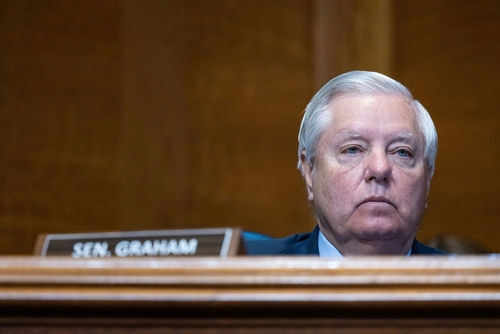
Senator Lindsey Graham boldly defended President Trump’s power to launch strikes on Iran, warning that Democrats’ War Powers push would turn 535 lawmakers into an absurd de facto Commander-in-Chief.
Story Snapshot
- Graham affirms Trump’s Article II authority to initiate military operations against Iran without congressional approval.
- Republicans in Congress rejected Sen. Tim Kaine’s resolution, greenlighting ongoing operations.
- Graham calls the 1973 War Powers Resolution unconstitutional, insisting Congress can only end wars by cutting funding.
- This upholds constitutional balance, protecting executive discretion amid Iran threats.
Graham’s Senate Floor Defense
Senator Lindsey Graham addressed the Senate floor ahead of a 4 PM vote on a War Powers resolution. He defended President Donald Trump’s authority as Commander-in-Chief under Article II of the Constitution to deploy forces against Iran. Graham argued this protects the nation from threats without needing prior approval. He contrasted this with Congress’s Article I power to declare war, noting only five formal declarations in U.S. history versus 125 presidential actions. This stance prioritizes swift executive response in defense matters.
Rejection of the War Powers Resolution
Senator Tim Kaine introduced a resolution to terminate Trump’s operations after 60 days, invoking the 1973 War Powers Resolution. Graham labeled this measure unconstitutional, a Vietnam-era overreach infringing on presidential authority. He warned passage would make all 535 members of Congress the de facto Commander-in-Chief, paralyzing decisions. Republicans in both the House and Senate declined to demand authorization, effectively supporting Trump’s “major combat operations.” Courts historically defer to the executive in such disputes.
Constitutional Balance and Historical Precedents
The U.S. Constitution assigns Congress the power to declare war while designating the President as Commander-in-Chief. Founders like George Washington urged congressional deliberation for offensive actions, yet presidents have acted independently in most cases. The 1973 resolution requires notification and potential termination after 60 or 90 days without approval. Graham emphasized Congress retains its power of the purse to end operations by defunding, preserving limited government checks without micromanaging defense. This framework echoes Trump’s 2020 Soleimani strike debates.
Harvard scholar Jack Goldsmith notes congressional acquiescence has expanded presidential war powers, allowing one person to make critical decisions. Graham framed opposition to strikes as against the Iranian people’s interests, supporting their “righteous demand” against the regime. Public skepticism and war fatigue persist, mirroring Vietnam-era concerns across political lines.
Ongoing Operations and Broader Implications
Trump initiated strikes recently, with operations continuing without formal declaration as the War Powers clock ticks. Congress’s rejection sustains presidential initiative, potentially setting a high-water mark for executive discretion. Funding battles loom in appropriations, polarizing Republicans who rally behind Trump and Democrats split on restraint. Long-term, this erodes congressional war powers unless countered by veto-proof action. Defense sectors benefit, but U.S. troops and Iranian civilians face risks amid unresolved tensions.
Sources:
Congress Declines to Demand a Say in the Iran War